Trading 360° view: Market SPY Weekly view, holidays, earnings, eco-news, market-news summary, news sentiment, and major ETFs, MAG7, Higher Time Frame Analysis Indices Futures Summary, and QQQ Weekly view.
SPY Weekly View
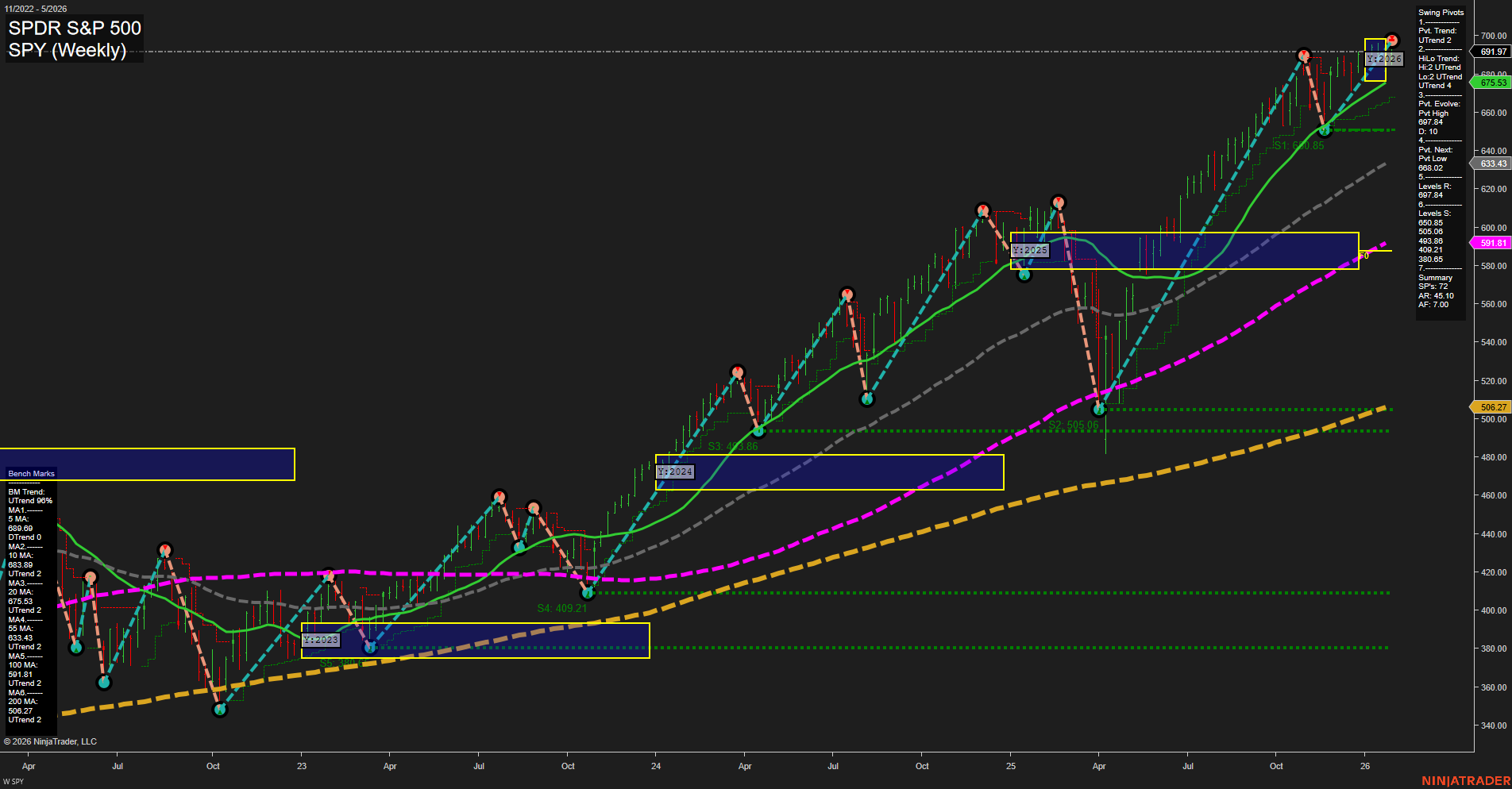
View weekly charts on: AlphaWebTrader HTF Charts
Holiday Radar
No U.S. market holidays pending in the next 7 days.
Earnings Radar
Monitoring for earnings releases by the Magnificent 7, AI-tech-related firms, and major financial institutions.
- MCHP Release: 2026-02-05 T:AMC
- AMZN Release: 2026-02-05 T:AMC
- GOOGL Release: 2026-02-04 T:AMC
- AMD Release: 2026-02-03 T:AMC
- SMCI Release: 2026-02-03 T:AMC
Earnings Summary and Market Conclusion for Indices Futures Day Traders:
Looking ahead, the upcoming week features a cluster of high-impact earnings reports from major tech and semiconductor names—AMD and Super Micro Computer (SMCI) release after market close on February 3, followed by Alphabet (GOOGL) on February 4, and Amazon (AMZN) alongside Microchip Technology (MCHP) on February 5, all after the close. These closely watched names are key drivers of both the NASDAQ and S&P 500 indices, ensuring heightened attention across futures markets. Historically, momentum and volume tend to slow in the sessions leading up to such heavyweight results as traders position or stay on the sidelines in anticipation of fresh guidance. With these events concentrated over a short period and directly related to the AI and MAG7 narrative, market sensitivity to forward-looking commentary and surprises (both positive and negative) is likely to be pronounced. Expect short-term index moves to be heavily headline-driven, with volatility likely to spike around the release windows as institutional and algorithmic participants react in real time. Broader risk sentiment may remain cautious until this round of earnings concludes and the market gains clarity, especially with traders also awaiting guidance from NVDA and other leading AI tech stocks soon after.
For full details visit: Yahoo Earnings Calendar
EcoNews Radar U.S. Events
EcoNews Summary
- Monday 10:00 – High impact: ISM Manufacturing PMI (USD). This report could move indices futures as it provides insight into US manufacturing sector strength and growth outlook. Large deviations from expectations often drive volatility, especially if they signal economic acceleration or contraction.
- Tuesday 10:00 – High impact: JOLTS Job Openings (USD). Traders watch this to gauge labor market tightness; higher openings may confirm strong job demand, influencing Fed policy outlook and risk asset reaction.
- Wednesday 08:15 – High impact: ADP Non-Farm Employment Change (USD). A key proxy for Friday’s NFP; surprises can prompt significant moves, particularly if data contradicts consensus NFP forecasts.
- Wednesday 10:00 – High impact: ISM Services PMI (USD). Critical for evaluating the dominant US services sector. Higher or lower readings relative to forecasts often fuel immediate index moves.
- Thursday 08:30 – High impact: Unemployment Claims (USD). Weekly data on labor market health. Spikes suggest economic stress, while declines can reinforce bullish sentiment.
- Friday 08:30 – High impact: Average Hourly Earnings m/m, Non-Farm Employment Change, Unemployment Rate (USD). This trio forms the core of the monthly US employment report (NFP). Outsized results or wage surprises can cause abrupt, high-volume risk re-pricing across index futures.
- Friday 10:00 – High impact: Prelim UoM Consumer Sentiment and Inflation Expectations (USD). These provide real-time insight into the consumer’s economic outlook and inflation expectations, both important input for equity market valuation and Fed policy speculation.
EcoNews Conclusion
- This week features concentrated high-impact data, especially around Wednesday and Friday’s major employment releases. Large market moves can occur if reports miss or beat consensus estimates.
- News events around the 10 AM time cycle often act as a catalyst for reversals or continuations—day traders should be prepared for increased volatility at those times.
- Market momentum and volume may slow in the days leading up to Friday’s NFP, with potential for rapid expansion in volatility once headline data is released.
For full details visit: Forex Factory EcoNews
Market News Summary
- S&P 500 & Indices: January closed with modest 1.4% gains, but technical indicators suggest waning momentum and risk of a pullback. February is historically weaker, and sentiment has edged lower, though the market remains near all-time highs. Futures for the S&P 500, Dow, and Nasdaq turned negative into the first week of February, partly in response to the nomination of Kevin Warsh as the next Federal Reserve Chair and valuations concerns. Trading volumes and volatility are elevated ahead of a busy earnings week—especially among big tech and AI-focused firms.
- Commodities: Oil prices initially surged from geopolitical tensions involving Iran but then sharply reversed—dropping as much as 5%—on signs of possible U.S.-Iran negotiations, reducing perceived supply disruption risks. Overhanging concerns about structural oil surplus could cap gains. Natural gas consolidated above key levels.
- Precious Metals: Gold price action was volatile, correcting after record highs and experiencing a sharp selloff, notably as the market priced in shifts related to Fed leadership. After plunging, gold recovered as traders re-evaluated support levels. Silver also faced a significant decline.
- Currencies & Macro: Asian currencies traded mixed as markets digested the potential policy impact of Warsh’s Fed nomination. Many investors cite interest rates and inflation as top risks for portfolios, with family offices turning toward alternative assets.
- Equity Sector Highlights: Valuation and concentration risks in U.S. equities are front of mind, especially in the large-cap tech and AI sectors. Debate persists over whether current valuations are sustainable or if the market is forming an AI-driven bubble.
- Global Developments: European economic data showed lackluster growth, with German retail sales barely increasing in December.
News Conclusion
- Market sentiment has shifted more cautious heading into February, with technical and macroeconomic signals prompting heightened attention to downside risks in both U.S. equities and commodity markets.
- Oil and metals saw sharp reversals, reflecting shifting geopolitical headlines and sensitivity to Fed policy expectations. Equities, particularly large-cap and tech sectors, remain sensitive to rising valuation concerns and continued earnings reports.
- Volatility is expected to remain elevated in the near term as traders navigate fluctuating macroeconomic factors, leadership transitions at central banks, and an active earnings calendar.
Market News Sentiment:
Market News Articles: 20
- Neutral: 45.00%
- Negative: 35.00%
- Positive: 20.00%
Sentiment Summary:
Out of 20 market news articles, 45% convey a neutral sentiment, 35% are negative, and 20% are positive.
Conclusion:
The overall news sentiment is predominantly neutral, with a notable portion of articles reflecting negative sentiment and a smaller share presenting positive outlooks.
GLD,Gold Articles: 7
- Neutral: 42.86%
- Negative: 42.86%
- Positive: 14.29%
Sentiment Summary:
Coverage on GLD/Gold is currently split, with neutral and negative sentiment each representing around 43% of recent articles, while positive sentiment is notably less prominent at about 14%.
This indicates cautious to negative tone in the latest news, with optimism limited relative to neutral or negative perspectives.
USO,Oil Articles: 9
- Neutral: 44.44%
- Negative: 33.33%
- Positive: 22.22%
Sentiment Summary: Recent news coverage on USO and the oil market reflects a predominantly neutral tone, with 44.44% of articles categorized as neutral. Negative sentiment appeared in 33.33% of the articles, while positive sentiment accounted for 22.22%.
This distribution indicates a mixed news environment, with the majority of commentary remaining impartial and a notable presence of negative sentiment outweighing the positive.
Market Data Snapshot
ETF Snapshot of major stock market ETFs, Mag7, and others as of: February 2, 2026 07:16
- TSLA 430.41 Bullish 3.32%
- USO 79.52 Bullish 0.48%
- AAPL 259.48 Bullish 0.46%
- GOOG 338.53 Bearish -0.04%
- IBIT 47.49 Bearish -0.23%
- DIA 489.03 Bearish -0.24%
- SPY 691.97 Bearish -0.30%
- TLT 87.13 Bearish -0.56%
- NVDA 191.13 Bearish -0.72%
- MSFT 430.29 Bearish -0.74%
- IJH 68.67 Bearish -0.91%
- AMZN 239.30 Bearish -1.01%
- QQQ 621.87 Bearish -1.20%
- IWM 259.65 Bearish -1.41%
- META 716.50 Bearish -2.95%
- GLD 444.95 Bearish -10.27%
ETF Stocks Summary
- SPY (S&P 500): 691.97, Bearish (-0.30%)
- QQQ (Nasdaq 100): 621.87, Bearish (-1.20%)
- IWM (Russell 2000): 259.65, Bearish (-1.41%)
- IJH (S&P MidCap 400): 68.67, Bearish (-0.91%)
- DIA (Dow Jones): 489.03, Bearish (-0.24%)
The major index ETFs are showing downside pressure across large, mid, and small caps in this market snapshot. Sentiment appears broadly negative for US equity benchmarks.
Mag7 Technology & Growth Breakdown
- AAPL (Apple): 259.48, Bullish (+0.46%)
- TSLA (Tesla): 430.41, Bullish (+3.32%)
- GOOG (Alphabet): 338.53, Bearish (-0.04%)
- MSFT (Microsoft): 430.29, Bearish (-0.74%)
- NVDA (Nvidia): 191.13, Bearish (-0.72%)
- AMZN (Amazon): 239.30, Bearish (-1.01%)
- META (Meta): 716.50, Bearish (-2.95%)
Among the Mag7, TSLA and AAPL are posting gains, in contrast with broad weakness seen in other key technology names. The sector as a whole shows a mixed to negative tilt.
Selected Sector & Thematic ETFs
- USO (Oil Fund): 79.52, Bullish (+0.48%)
- GLD (Gold ETF): 444.95, Bearish (-10.27%)
- TLT (US Treasuries): 87.13, Bearish (-0.56%)
- IBIT (Bitcoin ETF): 47.49, Bearish (-0.23%)
Mixed sentiment is evident in sector and thematic ETFs. USO (energy) shows positive momentum, while gold and Treasury bonds are under strong pressure. Bitcoin ETF IBIT is lower on the session.
Overall Market Tone (Snapshot)
This data snapshot indicates broad-based selling across indices, major tech stocks, and key alternative assets, with notable exceptions in TSLA, AAPL, and USO. The general tone suggests risk-off conditions, with few pockets of relative strength.
Higher Time Frame Analysis
Summary of the current state of US Indices Futures based on higher time-frame (HTF) technical analysis as of: 2026-02-02: 07:16 CT.
US Indices Futures
- ES Consolidating below YSFG, MSFG, WSFG F0% lines, HTF pivots show uptrend but recent high, support at 6730, resistance near highs, all MAs up, ST/IT bearish, LT bullish.
- NQ Below YSFG, MSFG, WSFG NTZ/F0%, HTF pullback, uptrend in ST pivots, neutral/IT downtrend, support at 23856/22351, bench MAs ST/IT down LT up, all signals short.
- YM Below YSFG, MSFG, WSFG F0% centers, ST/IT bearish with slow momentum, support 45705, resistance 48615, all weekly MAs up, in HTF retracement, long-term bullish structure.
- EMD Above YSFG, MSFG, WSFG NTZ/F0%, robust uptrend HTF, recent new high, ST pullback in daily, weekly all MAs up, support 3426/3345, resistance 3479/3571, volatility elevated.
- RTY Below WSFG, MSFG NTZ/F0%, weekly/daily ST/IT bearish, HTF YSFG up, swing pivot uptrend on weekly but near recent high, support 2350/2321, resistance 2568/2516, LT MA up.
- FDAX Above all key Fib grid levels on weekly, intermediate/long-term uptrend, ST pivot downtrend, support 24049/23599, resistance 25641, recent long signals, daily sees pullback with elevated volatility.
Overall State
- Short-Term: Bearish
- Intermediate-Term: Bearish
- Long-Term: Bullish
Conclusion
US Indices Futures are collectively in a corrective or pullback phase on higher time frames, with all major contracts (ES, NQ, YM, RTY) below key NTZ/F0% levels on YSFG, MSFG, WSFG, indicating prevailing downside structure in the short and intermediate term. Despite this, long-term uptrends remain intact for most indices, as confirmed by longer-term benchmark moving averages and YSFG uptrends. Recent pivot analysis identifies markets in or near support zones, with evolving high pivots and downside pressure dominating recent technical signals. FDAX and EMD maintain the strongest HTF bullish structure, while the US indices exhibit short/intermediate-term retracements within broader uptrends. Directional correlations are aligned to near-term weakness across US indices, while EMD and FDAX show greater resilience.
Note: Intra-day counter-trend pullbacks or retracements may occur, HTF is context for informational usage and market structure. Glossary: Session Fib Grids periods of YSFG:’Yearly’, MSFG:’Monthly’, WSFG:’Weekly’
For full details visit: AlphaWebTrader Technicals
Tech Weekly View
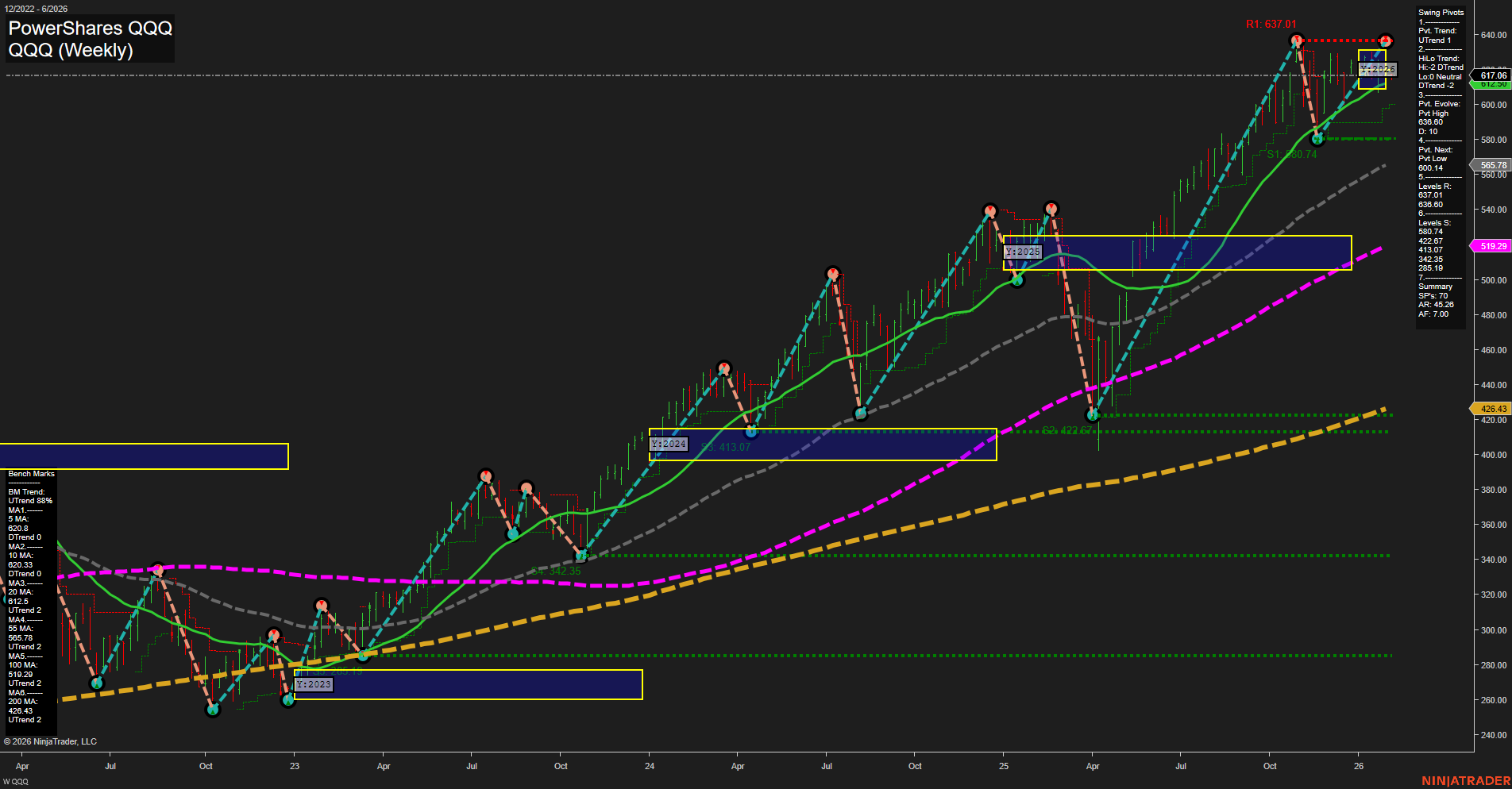
View weekly charts on: AlphaWebTrader HTF Charts