How Do Bonds Work? The Complete Lifecycle of a Bond
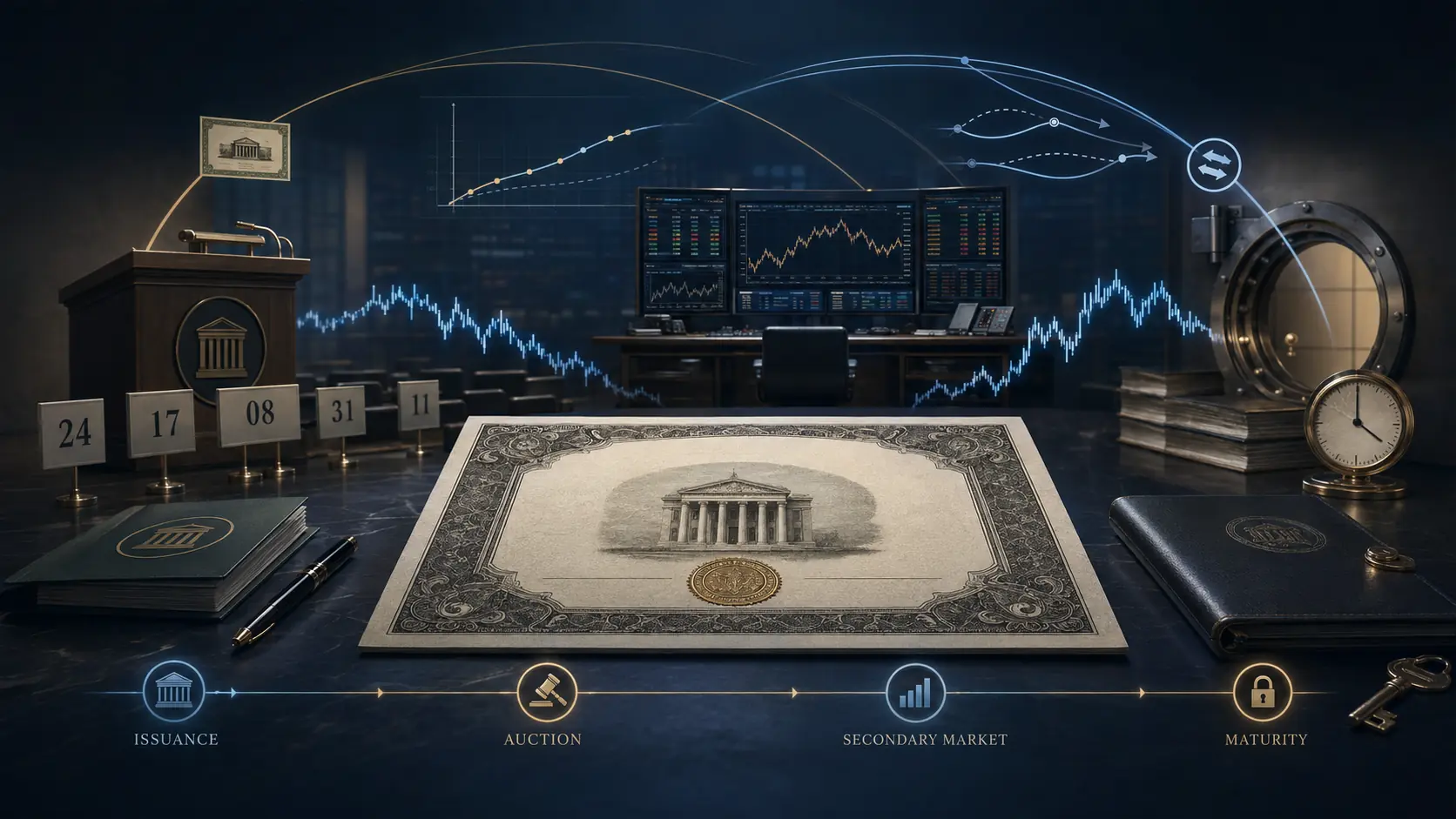
How does a bond begin, who buys it and what happens after issuance? This guide follows bonds from government auctions and corporate underwriting through secondary-market trading, dealer networks, futures, swaps and eventual maturity.
A bond begins as a loan. A government, company, municipality or agency needs capital, and investors provide that capital in exchange for a contractual claim on future payments. The security may then trade for years, changing owners and market value many times, even though its original coupon and maturity date normally remain fixed.
This is the companion guide to Yields Explained: What Bond Yields Mean for the Economy and Financial Markets. The first article explains why yields matter; this one follows the instrument itself from creation to redemption and separates actual bond ownership from futures, swaps and other derivative exposure.
What Is a Bond?
A bond is a debt security issued under a defined set of terms. The issuer promises to repay the bond’s face value, also called par value or principal, on a specified maturity date. Most bonds also pay periodic interest, known as the coupon.
The basic terms normally include:
- Issuer: the government, company, municipality or agency borrowing the money.
- Face or par value: the principal amount due at maturity.
- Coupon rate: the contractual annual interest rate applied to face value.
- Coupon schedule: the dates on which interest is paid.
- Maturity: the date on which principal is scheduled to be repaid.
- Seniority and security: where the claim ranks and whether assets secure it.
- Covenants and embedded options: conditions that may protect investors or allow an issuer to call the bond early.
- Credit risk: the possibility that the issuer will fail to make a payment in full and on time.
Although older bonds were represented by engraved certificates with detachable coupons, modern marketable bonds are generally electronic book-entry positions. Ownership is recorded through TreasuryDirect, banks, brokers, custodians and securities depositories rather than by passing a paper certificate between traders.
Stage 1: How a Bond Is Created
The lifecycle starts in the primary market, where the issuer sells a security for the first time and receives the proceeds. The method differs according to the issuer.
Government Bonds and Treasury Auctions
The U.S. Treasury raises money by selling marketable bills, notes, bonds, Treasury Inflation-Protected Securities and floating-rate notes. Before an auction, Treasury announces the security, amount offered, auction date, issue date and maturity.
Participants can submit two broad types of bids:
- Noncompetitive bids request an amount and accept the yield or rate established by the auction. This is the usual route for individuals buying through TreasuryDirect or an eligible financial institution.
- Competitive bids specify the yield, discount rate or discount margin the bidder is prepared to accept. These bids are commonly submitted by banks, dealers, investment funds and other institutions.
U.S. Treasury marketable securities are sold through a single-price auction process. Competitive bids are accepted from the lowest yield upward until the offering is allocated, and successful competitive and noncompetitive bidders receive the auction’s accepted high yield or equivalent price. At settlement, buyers pay Treasury and receive electronic securities.
Primary dealers have a formal role in the system. The Federal Reserve Bank of New York expects them to bid in Treasury auctions at reasonably competitive prices. They may retain awarded securities, distribute them to customers or trade them in the secondary market. They are important intermediaries, but they are not the only buyers.
A Treasury reopening adds supply to an existing security with the same maturity date, coupon and CUSIP rather than creating an entirely separate issue. The reopening price can be above, below or at par because market yields may have changed since the original auction.
Corporate Bonds and Underwriting
A company normally works with one or more investment banks to structure and distribute a new bond. The issuer and banks assess the amount to borrow, maturity, expected coupon, covenants, credit spread and investor demand. An underwriting syndicate may market the offering, collect orders and allocate bonds to investors.
Corporate bonds are often priced as a spread over a government or swap benchmark. If the comparable Treasury yield is 4.00% and investors require an additional 1.50 percentage points for the company’s credit and liquidity risk, the indicated corporate yield would be about 5.50% before final pricing adjustments.
The issuer receives the net proceeds after issuance costs. From that point, the company owes the promised interest and principal under the bond documents. Public offerings, private placements and municipal issues follow different disclosure and distribution rules, but the economic principle is the same: capital moves from the first buyers to the issuer.
Who Buys Bonds at Issuance?
The initial buyers depend on the security, size, currency, maturity and risk profile. They can include:
- Primary dealers and other securities dealers;
- Banks and corporate treasury departments;
- Pension funds and insurance companies;
- Mutual funds, exchange-traded funds and money-market funds;
- Hedge funds and relative-value traders;
- Foreign central banks, sovereign institutions and reserve managers;
- Municipal and public-sector investment pools; and
- Individual investors using TreasuryDirect or brokerage accounts.
Different buyers want different things. A pension fund may seek long-duration assets to match future liabilities. A money-market fund focuses on short maturities and liquidity. A bank may need high-quality collateral. A dealer may buy inventory to distribute or make markets. An individual may simply want predictable payments and the return of principal at maturity, subject to the issuer’s ability to pay.
Stage 2: How Actual Bonds Trade in the Secondary Market
After the primary distribution, existing bonds can be bought and sold in the secondary market. The issuer usually receives none of the money from these trades. Cash passes from the new buyer to the previous owner, and legal ownership of the bond changes through the settlement system.
Unlike shares concentrated on public stock exchanges, most bonds trade over the counter through banks, broker-dealers, electronic venues and institutional trading networks. A dealer may quote a bid at which it will buy and an offer at which it will sell. The gap is the bid-ask spread and partly compensates the dealer for inventory, capital and market risk.
The Treasury market is exceptionally large and liquid, with extensive electronic and interdealer trading. Corporate and municipal markets are more fragmented. Thousands of individual issues have different maturities, coupons, covenants and credit characteristics, and some may not trade on a particular day. FINRA’s TRACE system reports transaction information for eligible fixed-income securities and improves post-trade price transparency, but TRACE is a reporting system rather than a stock-style exchange order book.
Clean Price, Accrued Interest and Settlement
A conventional coupon bond is commonly quoted at its clean price, excluding interest accrued since the previous coupon payment. The buyer’s settlement amount normally uses the dirty price: clean price plus accrued interest. The next full coupon then goes to the buyer, who effectively reimbursed the seller for the seller’s portion of the coupon period.
A quote of 98.50 generally means 98.5% of face value, before accrued interest. A $1,000-face-value position would therefore have a clean value of $985. Institutional markets usually transact in much larger amounts.
Why Would an Investor Sell a Bond Before Maturity?
A bondholder is not required to wait for maturity. Common reasons for selling include:
- Raising cash: the owner needs liquidity for withdrawals, expenses, redemptions or another investment.
- Managing interest-rate risk: the investor expects yields to rise and wants to reduce duration before prices fall further.
- Managing credit risk: the issuer’s finances or rating outlook have deteriorated.
- Rebalancing: a portfolio has moved away from its target maturity, sector, currency or credit allocation.
- Matching liabilities: a pension fund, insurer, bank or corporation needs assets with different payment dates.
- Reducing leverage: a leveraged holder faces a margin call, higher financing costs or reduced repo availability.
- Meeting collateral rules: the security is no longer suitable or another asset is more efficient as collateral.
- Taking a profit or realizing a loss: the market price has moved, or the investor is managing tax and accounting outcomes.
- Switching to better relative value: another bond offers more attractive yield, liquidity or risk characteristics.
- Responding to forced flows: fund redemptions, index changes, regulatory limits or a downgrade may require a sale.
An investor may even sell a high-coupon bond. If market rates have fallen, that bond may trade at a premium and offer an opportunity to realize a capital gain. If market rates have risen above its coupon, the same bond may trade below par. The coupon alone does not tell the owner whether the bond is expensive or cheap.
Stage 3: Why Falling Bond Prices Increase Yields
The bond’s contractual cash flows do not normally change when it trades. What changes is the price a new owner pays for those cash flows. That is why bond prices and yields move in opposite directions.
Consider a bond with a $1,000 face value and a 4% annual coupon:
- The bond pays $40 a year regardless of whether its market price is $900, $1,000 or $1,100.
- At $1,000, its simple current yield is 4.00%.
- At $900, the same $40 represents a current yield of about 4.44%.
- At $1,100, the same $40 represents a current yield of about 3.64%.
Yield to maturity goes further than current yield. It also incorporates the remaining coupon schedule, time to maturity and the difference between the purchase price and the face value expected at redemption. A buyer paying $900 may receive $1,000 at maturity, so the yield to maturity would generally exceed the 4.44% current yield. The precise result depends on the remaining life of the bond and payment timing.
The new owner does not receive the original issue price at maturity. The owner receives the bond’s stated face value, assuming the issuer pays as promised. This distinction matters whenever a bond was first issued or later purchased above or below par.
A sale does not arbitrarily “add” yield to the bond. The transaction reveals the price at which a buyer and seller agree to transfer the fixed future cash flows. Once the market price falls, the calculated yield rises. Persistent selling pressure can push prices lower until buyers judge that the higher yield compensates them for interest-rate, inflation, credit, liquidity and other risks.
Stage 4: How Trading Across Maturities Reshapes the Yield Curve
The yield curve compares yields across maturities, such as three months, two years, 10 years and 30 years. It does not simply “grow” when bonds are sold. Different parts of the curve can reprice by different amounts.
- Parallel shift: short-, medium- and long-term yields move by roughly similar amounts.
- Steepening: long-term yields rise relative to short-term yields, or short yields fall faster.
- Flattening: the gap between long- and short-term yields narrows.
- Inversion: short-term yields rise above longer-term yields.
- Curvature change: intermediate maturities outperform or underperform the ends of the curve.
Central-bank expectations often exert the strongest direct influence on short maturities. Long bonds also reflect expected inflation, growth, fiscal supply, term premium and demand from liability-driven investors. Dealers and arbitrageurs compare neighboring securities, Treasury futures and swaps, helping transmit repricing from one maturity or market to another.
Stage 5: Cash Bonds, Futures, Swaps and Other Derivatives
Bond-market participants trade both actual securities and contracts whose value is derived from interest rates or credit. These are connected markets, but the instruments are not interchangeable.
| Instrument | What the Position Represents | Does the Trader Own a Bond? | Typical Purpose |
|---|---|---|---|
| Cash bond | A legal claim on the issuer’s coupon and principal payments | Yes | Income, capital preservation, collateral, liability matching or trading |
| Treasury future | A standardized contract tied to Treasury securities eligible for future delivery | No, unless the contract proceeds to delivery and a security is delivered | Hedging duration, taking a rate view, curve or basis trading |
| Option on a bond or futures contract | A right, but not an obligation, to buy or sell at specified terms | Not merely by owning the option | Defined-risk hedging or exposure to volatility and price direction |
| Interest-rate swap | An agreement to exchange fixed and floating interest cash flows on a notional amount | No | Changing fixed/floating exposure and managing duration |
| Credit default swap | A contract transferring defined credit risk of a reference borrower or security | No | Credit hedging or taking a view on default and credit spreads |
| Bond ETF or mutual fund | A share in a pooled portfolio that owns bonds and possibly related instruments | The fund owns the bonds; the investor owns fund shares | Diversified and readily traded fixed-income exposure |
Treasury Futures and the Deliverable Basket
CBOT Treasury futures are standardized exchange-traded contracts. Each note or bond futures contract has rules defining a basket of Treasury securities that may be delivered. The securities in that basket do not all have identical coupons and maturities, so conversion factors help standardize delivery economics.
One eligible issue will often be the cheapest to deliver: the bond that is economically most advantageous for the futures seller to deliver after considering its market price and conversion factor. This relationship links futures prices to cash Treasury prices. Arbitrage and hedging between the two markets create the Treasury basis.
Most futures positions are closed or rolled before delivery. Therefore, trading a Treasury future usually creates interest-rate exposure without the trader buying a specific Treasury bond. Nevertheless, delivery rules keep the futures contract anchored to actual securities.
Interest-Rate Swaps
In a plain fixed-for-floating interest-rate swap, one counterparty pays a fixed rate and receives a floating rate, while the other does the reverse. Payments are calculated on a notional principal amount, which is generally a reference amount rather than money exchanged at the start.
A receiver of fixed in a swap often gains exposure with similarities to owning a fixed-rate bond, while a payer of fixed often gains exposure that behaves more like being short duration. The comparison is not exact because a swap introduces different collateral, counterparty, clearing, liquidity and cash-flow features.
Credit Derivatives
Interest-rate derivatives mainly transfer exposure to the level and shape of rates. Credit derivatives focus on the possibility that a borrower will default or suffer another defined credit event. Credit default swap spreads and cash-bond credit spreads can influence one another as dealers hedge and relative-value traders compare the two markets.
How Derivatives Can Affect the Cash Bond Market
A derivative does not have to transfer a particular bond to influence bond prices. The connection works through hedging, arbitrage and price discovery.
For example, an institution can sell Treasury futures to reduce portfolio duration quickly. The dealer or arbitrageur taking the other side may hedge in cash Treasuries, swaps or other futures maturities. If the futures price becomes too high or low relative to deliverable bonds and financing costs, basis traders may buy one side and sell the other. These transactions pull the markets back toward an economically consistent relationship.
During normal conditions, this network improves liquidity and transmits information efficiently. During stress, leverage, margin calls, crowded basis trades and reduced dealer balance-sheet capacity can accelerate moves across both derivatives and cash bonds. A price move that begins in one market can therefore appear rapidly in the other.
Stage 6: What Happens at Maturity?
If a conventional bond reaches maturity without default, the final owner receives the stated face value plus any final coupon due. The security is then retired and ceases to trade.
There are important exceptions:
- A callable bond may be redeemed before its scheduled maturity under its terms.
- A convertible bond may be exchanged for shares under specified conditions.
- A sinking-fund provision may retire portions of an issue over time.
- A distressed issuer may restructure the debt, delay payments or default, leaving investors with an uncertain recovery.
- A perpetual bond may have no fixed maturity date.
For a plain bond held to maturity, interim market-price movements do not change the contractual redemption amount. They still matter economically: the holder may need to sell, report mark-to-market gains or losses, post collateral or compare the position with newer bonds offering different yields.
The Complete Bond Lifecycle in One Sequence
- An issuer decides how much to borrow and establishes the security’s terms.
- The bond is sold in a government auction, underwritten offering or private placement.
- Initial investors pay for the security, and the issuer receives capital.
- The bond begins trading in the secondary cash market through dealers and electronic venues.
- Its fixed cash flows are repriced as interest-rate expectations, inflation, credit risk, liquidity and supply change.
- Lower prices produce higher yields; higher prices produce lower yields.
- Repricing at different maturities changes the level, slope and curvature of the yield curve.
- Futures, swaps, options and credit derivatives interact with cash bonds through hedging, delivery, arbitrage and price discovery.
- At maturity, the issuer repays face value to the final holder, unless the bond has been called, converted, restructured or defaulted.
Final Perspective
A bond is born in the primary market but may spend most of its life in the secondary market. Its coupon is the contractual interest payment set by the security; its yield is the market’s constantly changing return calculation based on price and expected cash flows. Investors can own the actual bond, trade a pooled fund or use derivatives to transfer interest-rate and credit exposure without owning that specific security.
Understanding that distinction makes the wider bond market easier to read. Auctions determine how new supply enters the system. Secondary trading determines the price of existing cash flows. Derivatives redistribute risk and connect different points of the curve. Maturity finally closes the original loan.
Continue with: What Bond Yields Mean for the Economy and Financial Markets.