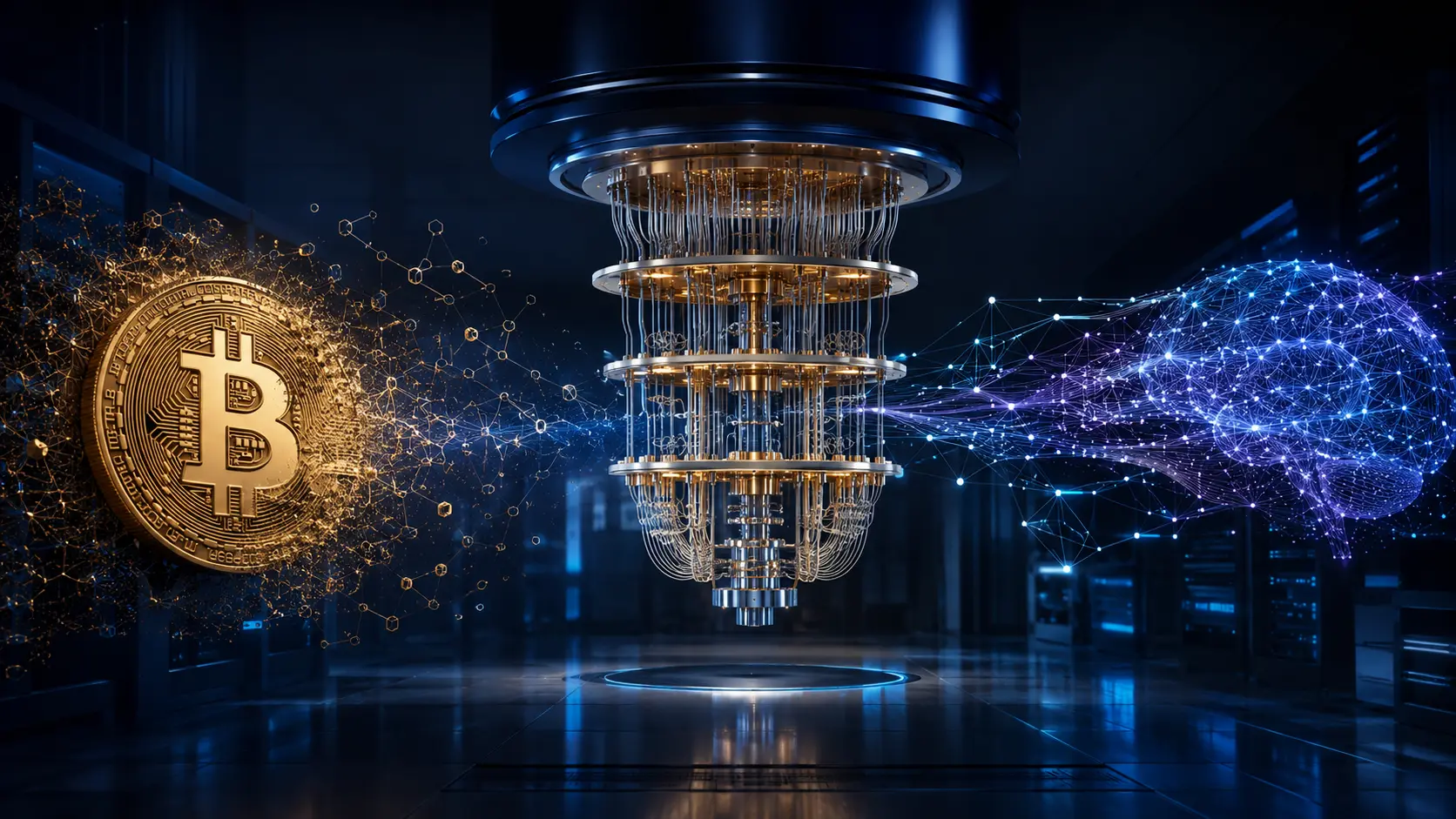
Quantum computing is moving from a century of physics into a contest among governments, universities, technology giants and highly speculative public companies. It may eventually transform chemistry, materials science, optimization and cryptography—but it is not a magical replacement for the computers, GPUs or artificial-intelligence systems used today.
Quantum computing in five points
- A quantum computer is a specialized co-processor, not a universally faster PC.
- Its power comes from controlling superposition, entanglement and interference—not from trying every answer and reading them all at once.
- The central engineering problem is error: useful logical qubits may require many fragile physical qubits plus continuous correction.
- A sufficiently capable fault-tolerant machine could defeat RSA and elliptic-curve public-key cryptography. That includes the digital signatures protecting Bitcoin and many other cryptocurrencies.
- AI is already helping scientists control and stabilize quantum hardware. Claims that quantum computing will soon make ordinary AI or large language models exponentially better are far less established.
What is quantum computing?
A classical bit records either 0 or 1. A quantum bit, or qubit, is a controlled quantum system whose state can be represented as a combination of 0 and 1 until it is measured. Several qubits can also become entangled, producing correlations that have no simple classical equivalent.
This does not mean a quantum computer returns every possible answer. A quantum algorithm manipulates probability amplitudes so that interference suppresses many wrong outcomes and increases the probability of measuring a useful one. IBM’s quantum-computing explainer describes the process as preparing states, applying quantum gates and using interference to amplify desired outcomes.
The machine therefore needs the right algorithm, an efficiently encoded problem and hardware that can preserve quantum information for long enough to finish the calculation. Most everyday workloads—including web browsing, accounting, databases, video and ordinary AI inference—receive no automatic advantage.
The best mental model: a future data center may combine CPUs for general work, GPUs for parallel numerical work and AI, and QPUs for selected quantum subroutines.
A brief biography of quantum computing
Quantum computing was not invented in one laboratory on one date. It grew from an unusual sequence: physicists discovered that nature does not follow classical intuition; mathematicians converted those discoveries into an information theory; and engineers then began constructing devices able to control the effects.
1900–1935: the physics is discovered
In 1900, Max Planck proposed that energy is exchanged in discrete packets, or quanta, to explain black-body radiation. Albert Einstein used the quantum idea to explain the photoelectric effect in 1905. Niels Bohr applied quantized energy levels to the atom. In the 1920s, Werner Heisenberg and Erwin Schrödinger developed different but equivalent mathematical forms of quantum mechanics.
In 1935, Einstein, Boris Podolsky and Nathan Rosen highlighted the strange correlations later called entanglement, while Schrödinger introduced both the term and his famous cat thought experiment. These scientists were not designing a new laptop. They were trying to explain how matter and light actually behave.
1980–1985: computation becomes quantum
Paul Benioff described a quantum-mechanical model of a Turing machine in 1980. Richard Feynman then argued that classical computers struggle to simulate quantum physics efficiently and proposed using nature’s own quantum behavior to perform the simulation. In 1985, David Deutsch formalized the idea of a universal quantum computer.
1994–1996: algorithms give the machine a purpose
In 1994, MIT mathematician Peter Shor published an algorithm that could factor large integers and solve discrete logarithms efficiently on a sufficiently capable quantum computer. That discovery converted quantum computing from an intriguing physics project into a strategic cybersecurity issue. Shor also produced a foundational quantum error-correcting code.
In 1996, Lov Grover introduced a quantum search algorithm requiring roughly the square root of the steps needed by an unstructured classical search. IBM’s Grover learning module explains why this is a quadratic—not unlimited—speed-up.
2001–2019: experimental machines arrive
An IBM-led experiment factored the small number 15 using Shor’s algorithm in 2001. D-Wave later commercialized quantum annealers aimed at optimization, although annealing is different from a universal gate-based computer. Superconducting, trapped-ion, photonic, neutral-atom and semiconductor-spin approaches developed in parallel.
In 2019, Google reported that its Sycamore processor completed a specialized sampling benchmark beyond the practical reach of then-current classical methods. The phrase quantum supremacy attracted headlines, but a benchmark victory did not mean that quantum computers had become broadly useful.
2024–2026: error correction, standards and a commercial race
Google’s 105-qubit Willow processor demonstrated below-threshold surface-code error correction: as the code became larger, the encoded error rate fell. This is an important condition for scalable fault tolerance, although Willow is not itself a cryptographically relevant quantum computer.
The 2025 Nobel Prize in Physics recognized John Clarke, Michel Devoret and John Martinis for experiments that demonstrated macroscopic quantum tunneling and energy quantization in electrical circuits—work that helped establish the physical foundations of superconducting quantum hardware.
At the same time, governments stopped treating the cryptographic risk as a distant theory. In August 2024, the U.S. National Institute of Standards and Technology finalized its first three post-quantum cryptography standards and urged organizations to begin migration.
The next phase remains competitive and uncertain. IBM says it is targeting a 200-logical-qubit, fault-tolerant system called Starling for 2029. Google, Quantinuum, IonQ, QuEra, PsiQuantum, Xanadu, Rigetti, D-Wave, Amazon and Microsoft are pursuing different technologies. Microsoft’s Majorana-based approach has received particular scrutiny; a June 2026 Reuters report covered renewed scientific challenges to evidence underlying the company’s topological-qubit program.
How a quantum computer is built
There is no settled equivalent of the silicon transistor for quantum computing. Each platform trades speed, fidelity, connectivity, operating environment and manufacturability against one another.
| Qubit approach | How it works | Strength | Central challenge | Examples |
|---|---|---|---|---|
| Superconducting circuits | Microscopic electrical circuits cooled near absolute zero | Fast gates and established chip fabrication | Noise, cryogenics and error-correction overhead | IBM, Google, Rigetti, Amazon |
| Trapped ions | Charged atoms held by electromagnetic fields and controlled by lasers | High fidelity and long coherence | Gate speed and system scaling | Quantinuum, IonQ |
| Neutral atoms | Uncharged atoms arranged and controlled with optical tweezers | Large, reconfigurable arrays | Uniform control and reliable gate operations | QuEra, Atom Computing, Pasqal |
| Photonic | Quantum information carried by particles of light | Networking potential and less dependence on deep cryogenics | Photon loss, sources, detectors and fault-tolerant scale | PsiQuantum, Xanadu |
| Semiconductor spin | Electron or nuclear spin controlled in silicon devices | Potential compatibility with semiconductor manufacturing | Precision control and interconnection | Intel and university programs |
| Topological | Information would be encoded in states designed to resist local noise | Potentially lower error-correction burden | The necessary physical states and scalable qubits remain disputed | Microsoft |
| Quantum annealing | A system is guided toward a low-energy solution | Specialized optimization and sampling | Limited problem class and contested comparisons | D-Wave |
The visible gold “chandelier” associated with superconducting quantum computers is primarily a dilution refrigerator, wiring and shielding—not the processor alone. The QPU is typically a small device deep inside the system. Lasers, microwave electronics, cryogenics, control software, conventional servers and real-time decoders make the machine function.
Raw qubit counts are therefore a weak league table. Investors and researchers should also ask about gate fidelity, connectivity, coherence, logical error rate, circuit depth, gate throughput and whether results beat the strongest current classical method.
What quantum computers may actually do
The most natural quantum application is simulating quantum systems. Molecules, catalysts, batteries and advanced materials are quantum objects, but their possible states become extraordinarily expensive to model classically as complexity rises. The U.S. Department of Energy is funding research into quantum computation for chemistry and materials science.
- Chemistry and materials: catalysts, fertilizers, batteries, superconductors and industrial processes.
- Drug research: molecular structure and interaction studies, usually within a larger classical workflow.
- Optimization: logistics, scheduling, network design and selected portfolio problems—provided a real advantage survives data-loading and error-correction costs.
- Scientific simulation: quantum physics, high-energy physics and complex materials.
- Cryptanalysis: Shor’s algorithm against factoring and discrete-logarithm systems.
- Sampling and linear algebra: possible subroutines for scientific computing and machine learning.
“Possible” matters. A theoretical speed-up is not automatically a useful commercial advantage. The full comparison must include encoding classical data, correcting errors, executing the circuit, repeating measurements and validating the result against the best CPU, GPU or specialized classical algorithm.
What happens to cryptography?
A large fault-tolerant quantum computer would not break all security in the same way. The sharpest divide is between public-key cryptography and symmetric cryptography.
| Technology | Quantum effect | Practical response |
|---|---|---|
| RSA, Diffie-Hellman and elliptic-curve cryptography | Shor’s algorithm could efficiently solve the underlying factoring or discrete-logarithm problem | Migrate to post-quantum key establishment and signatures |
| AES and other symmetric ciphers | Grover’s algorithm offers a quadratic brute-force improvement in the idealized model, not Shor’s collapse | Use appropriate key sizes and updated security guidance |
| Cryptographic hashes | Quantum search can reduce some security margins, but does not simply reveal every preimage | Use strong hash sizes and quantum-aware protocols |
| Post-quantum cryptography | Designed around problems not known to be efficiently solvable by quantum computers | Deploy standardized algorithms and retain crypto-agility |
NIST’s first completed standards are ML-KEM for establishing shared secrets, ML-DSA as the principal post-quantum digital-signature standard and SLH-DSA as a hash-based signature alternative. These algorithms run on classical computers; organizations do not need a quantum computer to become quantum-resistant.
The immediate security concern is harvest now, decrypt later. An adversary can collect encrypted traffic today and retain it until future hardware can attack the old public-key protection. Data that must remain confidential for many years therefore needs earlier migration than short-lived information.
What happens to Bitcoin?
Quantum computing creates a serious but potentially manageable upgrade problem for Bitcoin. It does not mean that every coin, block and hash suddenly disappears.
The principal risk: digital signatures
Bitcoin uses elliptic-curve digital signatures—ECDSA and, for Taproot, Schnorr over secp256k1—to prove that a spender controls a private key. A cryptographically relevant quantum computer running Shor’s algorithm could derive a private key from its corresponding public key. An attacker could then forge a valid spend.
Some older outputs and reused-address patterns have public keys visible on-chain indefinitely. In common pay-to-public-key-hash outputs, the public key is hidden behind a hash until the owner spends. That provides additional protection while the output remains unspent, but it is not a permanent quantum shield: the public key becomes visible when a transaction is broadcast. If a future attacker could recover the private key inside Bitcoin’s settlement window, an “on-spend” theft could become possible.
Research estimates are moving quickly and depend heavily on assumed hardware. A March 2026 Google Quantum AI assessment argued that elliptic-curve attacks may require fewer resources than earlier estimates. These are resource projections, not evidence that a machine capable of attacking Bitcoin exists today.
What about SHA-256 and mining?
Bitcoin’s proof of work uses SHA-256. Grover’s algorithm could theoretically reduce the number of trials required for an unstructured search from roughly N to roughly the square root of N. That is meaningful, but it is not the same as Shor’s attack on signatures. A quantum miner would still face enormous hardware, error-correction, speed and energy constraints, while Bitcoin’s difficulty adjustment and competition would alter the economics.
A quantum computer would not automatically reverse confirmed blocks, discover every private key from an address or create unlimited bitcoins. The signature layer is the more direct systemic risk.
Can Bitcoin be upgraded?
Yes in principle, but the change is as much about governance and migration as mathematics. Bitcoin developers are discussing quantum-resistant signature checks, recovery schemes and the difficult treatment of coins that fail to migrate. Bitcoin Optech’s quantum-resistance topic tracks the technical discussion.
A credible transition could require:
- agreement on one or more post-quantum signature schemes;
- a consensus upgrade that supports new output and spending rules;
- wallet, exchange, custodian and hardware-wallet support;
- a long period for holders to move funds to protected outputs; and
- a social decision about visibly vulnerable, inactive or apparently lost coins.
Post-quantum signatures can be much larger than current Bitcoin signatures, affecting block space, fees and validation. The challenge is therefore not “Can cryptographers invent an algorithm?” NIST has already standardized relevant families. The challenge is deploying a secure, efficient and widely accepted Bitcoin migration before an attacker can exploit the old system.
What happens when quantum computing meets AI?
The collision is already occurring, but mostly in the direction opposite to the popular story.
1. AI helps build the quantum computer
Quantum processors drift, accumulate noise and require constant calibration. Machine learning can assist with device design, pulse control, circuit compilation, noise modeling, experiment selection and error decoding. In July 2026, Google reported a reinforcement-learning system integrated with quantum error correction that adapted to changing conditions while computation continued.
This is a powerful feedback loop: classical AI analyzes the flood of control and syndrome data produced by a QPU, then helps the system remain stable enough to perform longer calculations.
2. Quantum computers may help selected AI workloads
Quantum machine learning explores quantum kernels, optimization, sampling, generative models and linear-algebra subroutines. The strongest theoretical advantages often concern quantum data—information produced by a quantum system and naturally represented in quantum form.
For ordinary classical datasets, a major obstacle is loading the data into quantum states without consuming the proposed speed-up. Noise, limited circuit depth, repeated measurement and powerful classical competitors create further barriers. There is currently no established general-purpose quantum accelerator that trains or runs mainstream large language models better and more economically than leading GPU systems.
3. The likely architecture is hybrid
The realistic model is not “quantum replaces AI.” It is a CPU-GPU-QPU system in which classical software prepares a problem, an AI system helps select or optimize circuits, a QPU runs a specialized subroutine, and classical machines validate and integrate the result. IBM calls this direction quantum-centric supercomputing.
4. AI could accelerate both defense and attack
AI can inventory vulnerable encryption, assist code migration, search for better post-quantum implementations and help operate quantum hardware. The same capabilities could help an attacker identify high-value public keys, automate transaction interception or optimize cryptanalytic workflows. AI does not remove the need for a cryptographically relevant quantum machine, but it may reduce the organizational and engineering friction surrounding one.
The investor’s view: breakthrough technology, early business models
Quantum computing is investable before it is mature, which makes it vulnerable to the same pattern seen in railways, telecoms, the internet and AI: the technology can be transformative while many early equity valuations, forecasts and companies still fail.
The market contains two different risk groups:
- Diversified platforms: Alphabet, IBM, Microsoft, Amazon, Intel and Nvidia can finance long research cycles from other businesses. Quantum success may be strategically important without yet being material to group revenue.
- Pure or concentrated plays: IonQ, Rigetti and D-Wave offer greater sensitivity to quantum headlines, contracts and technical milestones, but also greater valuation, dilution, revenue-concentration and execution risk.
Private and recently commercializing names include Quantinuum, QuEra, PsiQuantum, Xanadu, Atom Computing and Pasqal. An August 2026 Oracle–Quantinuum cloud partnership illustrates how commercialization is likely to begin: expensive quantum systems accessed remotely and integrated with classical cloud infrastructure.
For investors, the most useful questions are not “How many qubits?” or “Did the share price rise after a press release?” They are:
- Are the results peer-reviewed, independently reproducible and compared with the best classical method?
- Are qubits physical or error-corrected logical qubits?
- Does performance improve when the system scales?
- Is there a paid use case rather than a research demonstration?
- How much cash, dilution and capital expenditure are required before sustainable revenue?
- Does the company control a defensible layer—hardware, control electronics, cryogenics, networking, software, algorithms or cloud distribution?
Quantum computing may eventually become a critical part of the compute stack. It is not yet the next mass-market PC, the next GPU cycle or a guaranteed replacement for today’s AI infrastructure.
Quantum myths and reality
- Myth: a qubit is both 0 and 1, so it gives two answers at once.
- Reality: the state can be a superposition, but measurement produces a classical outcome. The algorithm must use interference to make useful outcomes more probable.
- Myth: more physical qubits always mean a better computer.
- Reality: noisy qubits with poor fidelity or connectivity may be less useful than a smaller, better-controlled system.
- Myth: quantum computers will make every program exponentially faster.
- Reality: proven large advantages apply to particular problem structures and algorithms.
- Myth: Bitcoin becomes worthless the day a powerful quantum computer appears.
- Reality: its current signatures would face a severe threat, but the network can adopt new rules and users can migrate. Timing, coordination and treatment of unmoved coins determine the outcome.
- Myth: post-quantum security requires quantum hardware.
- Reality: post-quantum algorithms run on classical computers and can be deployed now.
- Myth: quantum AI is already replacing GPUs.
- Reality: AI is currently more useful for improving quantum hardware than quantum hardware is for mainstream AI.
Quantum-computing glossary
- Amplitude
- A complex number associated with a possible quantum outcome; its squared magnitude contributes to the outcome’s probability.
- Annealing
- A specialized quantum approach that guides a system toward a low-energy configuration representing a possible optimization solution.
- Bloch sphere
- A geometric representation of a single qubit’s pure state.
- Coherence time
- How long a qubit preserves usable quantum information before environmental interaction destroys it.
- Cryptographically relevant quantum computer (CRQC)
- A fault-tolerant quantum computer powerful enough to defeat important real-world public-key cryptography.
- Decoherence
- The loss of quantum behavior through interaction with the environment.
- Entanglement
- A quantum relationship in which the joint state of qubits cannot be described as independent individual states.
- Error mitigation
- Techniques that reduce or estimate the effect of noise without providing full fault tolerance.
- Fault tolerance
- The ability to continue a quantum calculation reliably despite errors, using encoded information and corrective procedures.
- Fidelity
- A measure of how closely a prepared state or executed gate matches the intended result.
- Grover’s algorithm
- A quantum algorithm providing a quadratic speed-up for unstructured search in an idealized setting.
- Harvest now, decrypt later
- Collecting encrypted information today in anticipation of decrypting it with future quantum capabilities.
- Interference
- The combining of quantum amplitudes so that some outcomes are strengthened and others canceled.
- Logical qubit
- An error-corrected unit of quantum information encoded across multiple physical qubits.
- Measurement
- The process that converts quantum information into a classical result sampled according to the state’s probabilities.
- NISQ
- “Noisy intermediate-scale quantum”: the present era of imperfect devices without full fault tolerance.
- Physical qubit
- An individual hardware implementation of a qubit, such as a superconducting circuit, trapped ion, atom, photon or electron spin.
- Post-quantum cryptography (PQC)
- Classical cryptographic algorithms designed to resist known attacks from both classical and quantum computers.
- Quantum advantage
- A demonstrated benefit from a quantum method over relevant classical methods on a defined task. A benchmark advantage may not yet be commercially useful.
- Quantum circuit
- An ordered sequence of quantum gates and measurements that implements an algorithm.
- Quantum error correction (QEC)
- Encoding quantum information across multiple qubits and repeatedly detecting errors without directly measuring the protected information.
- Quantum gate
- A controlled operation that transforms one or more qubit states.
- Quantum machine learning (QML)
- The study of algorithms at the intersection of quantum computing and machine learning.
- Quantum supremacy
- A term for completing a specific calculation beyond feasible classical computation; many researchers prefer “quantum computational advantage.”
- QPU
- Quantum processing unit: the component that executes quantum circuits.
- Qubit
- The basic unit of quantum information.
- Shor’s algorithm
- A quantum algorithm for integer factoring and discrete logarithms that threatens RSA, Diffie-Hellman and elliptic-curve cryptography.
- Superposition
- A quantum state represented as a combination of basis states before measurement.
- Surface code
- A leading quantum error-correction method that arranges physical qubits in a lattice and detects errors through repeated local checks.
The bottom line
Quantum computing has not taken on a life of its own. It is the result of a century-long chain of physical discovery, mathematical design and difficult engineering. Nature supplied the strange rules; people learned how to express them as algorithms and are still learning how to build machines that can use them reliably.
The near-term impact is already real in one field: security planning. Governments and companies are migrating cryptography before a cryptographically relevant machine exists. Bitcoin faces a slower and more political version of the same transition because its rules, wallets and dormant holdings must move through decentralized consensus.
AI and quantum computing are more likely to become partners than rivals. AI can help control quantum machines; quantum processors may eventually accelerate selected scientific and learning subroutines; and classical computers will coordinate the complete system. The eventual breakthrough will probably look less like one all-powerful computer and more like a new specialized engine inside the global compute infrastructure.