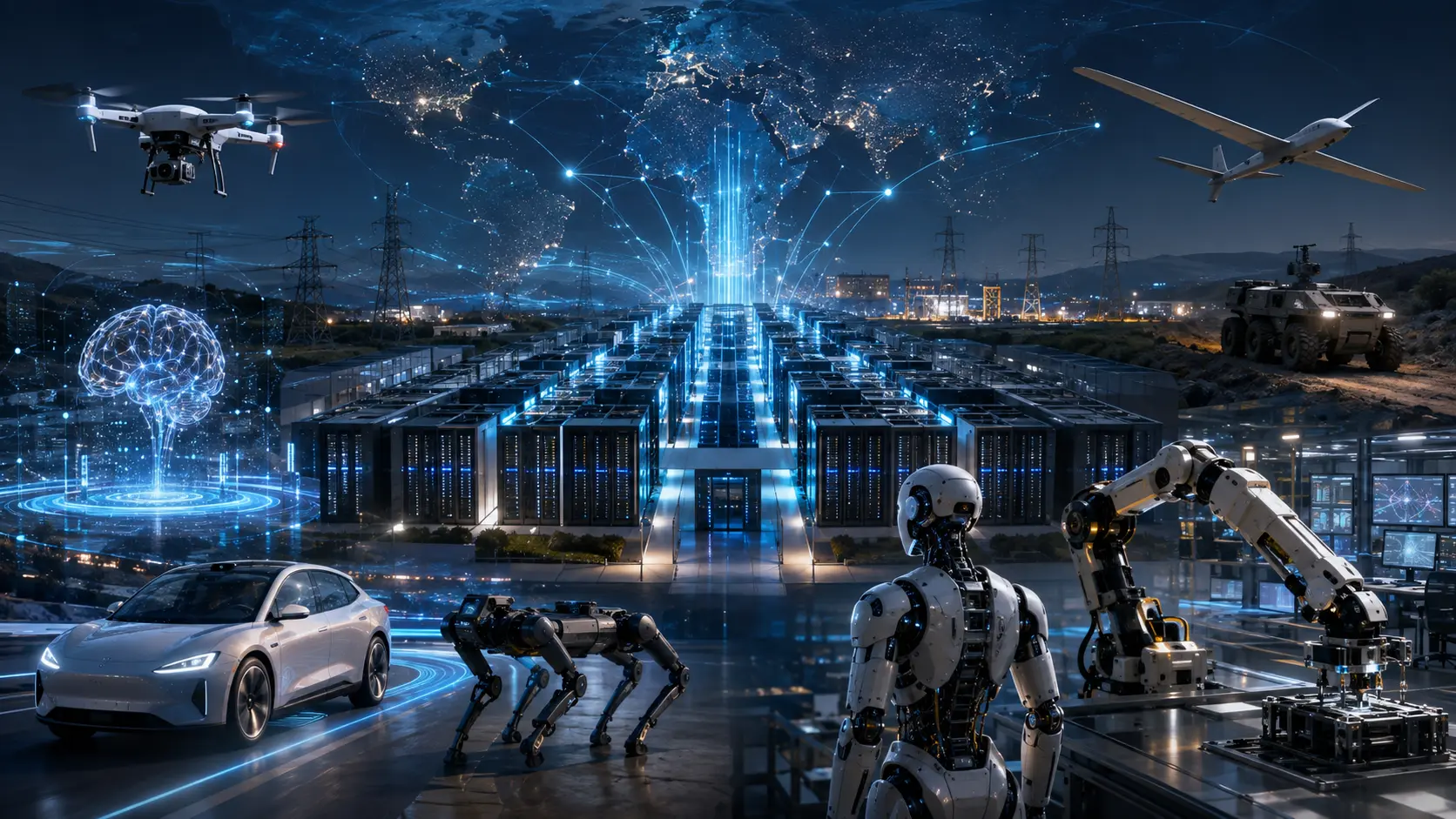
Artificial intelligence is not one product and not one industry. It is a family that begins with electricity, land, semiconductors and data centers; develops through machine learning and foundation models; reaches users through copilots, agents and automation; and finally moves into the physical world through industrial robots, humanoids, robot dogs, autonomous vehicles, aircraft, drones and military systems.
The phrase AI capex became one of Wall Street’s defining buzzwords from 2024 onward because investors needed a simple name for the enormous capital buildout behind this family. The phrase sounds technical, but the central question is straightforward: who is spending the money, what are they buying, what will it do, when will it generate revenue, and will the return justify the cost?
AI capex: the financial gateway to the AI family
What is AI capex?
AI capex means capital expenditure used to create or expand the long-lived physical infrastructure required to develop and operate artificial intelligence. It normally appears on the cash-flow statement as purchases or additions to property and equipment rather than as a separate standardized accounting line called “AI capex.”
It can include data-center land and buildings, servers, GPUs and other accelerators, CPUs, high-bandwidth memory, networking equipment, storage, cooling systems, substations and backup power. Depending on the company and contract, it may also include assets obtained through finance leases.
This is why reported figures are not automatically comparable. Alphabet describes capex mainly through property and equipment, including servers, networking and data-center construction. Meta includes principal payments on finance leases in its capex measure. Microsoft often discusses both additions to property and equipment and capital expenditure including finance leases. Investors must read the definition before comparing the headline numbers.
Who spends it?
- Hyperscalers and cloud platforms build the largest general-purpose fleets of AI compute.
- Consumer and advertising platforms invest to improve recommendations, advertising, search, content and their own generative-AI products.
- Frontier AI laboratories need enormous training and inference capacity, usually supplied through a cloud partner, leases or dedicated infrastructure.
- Specialist AI clouds or “neoclouds” rent concentrated GPU capacity to model developers and enterprises.
- Colocation and data-center operators build powered shells, campuses and interconnections for tenants.
- Utilities, grid operators and energy developers invest in generation, transmission, substations and storage to supply the new load.
- Semiconductor manufacturers and their suppliers invest in fabrication plants, packaging, memory and manufacturing equipment.
- Telecom, industrial, automotive, aerospace, robotics and defence companies fund edge compute, sensors, factories and AI-enabled machines.
- Governments and sovereign funds support domestic compute capacity, research, defence, public services and data sovereignty.
What is it for?
AI infrastructure supports several workloads: pre-training foundation models, post-training and fine-tuning, generating synthetic data, running inference for customers, recommendation engines, search, advertising, cybersecurity, scientific computing, industrial optimization and the perception-and-control systems used by physical machines.
One server cluster can therefore serve more than a single chatbot. The economic aim is to create a flexible compute fleet that can be shifted toward the workloads producing the highest demand and return.
Why did AI capex become a buzzword after 2024?
Generative AI turned computing capacity into a strategic bottleneck. Demand moved from traditional cloud workloads toward dense clusters of accelerators connected by very fast networks and supported by far more power and cooling. In April 2024, Alphabet explicitly said the strong year-over-year increase in capex reflected its confidence in AI opportunities, helping make the term a recurring focus of technology earnings calls.
By 2026 the scale had moved again. Alphabet reported $91.4 billion of capex for 2025 and expected $175 billion to $185 billion in 2026, with roughly 60% directed to servers and 40% to data centers and networking. Meta reported $31.08 billion of capex in the second quarter of 2026 and guided to $130 billion to $145 billion for the full year. Microsoft reported $80.15 billion of additions to property and equipment in the first nine months of its 2026 fiscal year. Amazon said the year-over-year increase in trailing-12-month property-and-equipment purchases was $66.1 billion and primarily reflected AI investment.
These figures should not be added into a supposed industry total because the periods, definitions, leases and non-AI components differ. They do, however, show why AI capex is no longer a niche line item.
When does capex become an expense or revenue?
Capex leaves the cash-flow statement when the asset is purchased, but it normally reaches the income statement gradually through depreciation after the asset is ready for use. Alphabet, for example, says servers and network equipment are generally depreciated over six years, while buildings can have much longer useful lives.
The sequence matters:
- Land, power, buildings and equipment are ordered.
- Cash may be paid months before useful capacity arrives.
- Installation, networking, testing and customer deployment follow.
- Depreciation and operating costs begin as assets enter service.
- Revenue arrives only when the capacity is used internally or sold to customers.
This timing gap explains why free cash flow can weaken before AI revenue fully appears. It also creates the central risk of the cycle: companies may build too little and lose strategic position, or build too much and carry underused, rapidly ageing equipment.
AI capex, AI opex and AI investment
- Capital expenditure (capex)
- Cash used to acquire or build long-lived assets such as servers, data centers and network infrastructure.
- Operating expenditure (opex)
- Current-period costs such as electricity, cloud rentals, software licences, maintenance, employee compensation and much of research and development.
- AI investment
- The broadest expression. It can include capex, research, salaries, acquisitions, equity stakes, model-training contracts and energy agreements. Not every AI investment is capex.
- Finance lease
- A financing arrangement that gives a company long-term use of an asset and can make economically similar infrastructure appear differently across reported cash-flow measures.
- Depreciation
- The accounting allocation of an asset’s cost over its estimated useful life. It is non-cash in the current period, but it represents the consumption and ageing of earlier investment.
- Stranded AI assets
- Infrastructure that cannot earn the expected return because demand, hardware standards, model efficiency, regulation or power availability changes.
AI infrastructure glossary: data centers, chips, networks and power
- Compute
- The processing capacity used to train or run AI models. It can be discussed in terms of chips, clusters, operations, accelerator-hours, tokens per second or effective output per dollar.
- Data center
- A facility containing servers, storage and networking systems, together with power distribution, cooling, security and connectivity. An AI data center is optimized for dense accelerator clusters and high-power workloads.
- AI factory
- An industry term for infrastructure that converts electricity, data and computing capacity into trained models, predictions or generated tokens. It emphasizes that compute is productive industrial capacity rather than merely back-office IT.
- Hyperscaler
- A company operating cloud and data-center infrastructure at enormous global scale. Hyperscalers can spread fixed costs across many products and customers.
- Neocloud
- A newer specialist cloud provider concentrated on GPU-rich AI workloads rather than a full catalogue of traditional cloud services.
- GPU
- A graphics processing unit. Its ability to perform many calculations in parallel made it central to modern AI training and inference.
- AI accelerator
- A broader category of chips designed to speed AI calculations. GPUs, TPUs, NPUs and custom ASICs are all types of accelerator.
- TPU, NPU and ASIC
- A TPU is a tensor-oriented accelerator; an NPU is a neural processing unit often used in devices; an ASIC is a custom chip designed for a narrower set of tasks. These terms overlap in practice but are not identical.
- CPU
- The general-purpose processor that coordinates systems and handles workloads that do not require massive parallel acceleration.
- HBM
- High-bandwidth memory positioned close to an accelerator so large volumes of model data can move quickly. HBM supply and advanced packaging can be as important as the processor itself.
- Cluster
- A group of connected servers operating as one computing system. Large AI training clusters require exceptionally fast, reliable communication between accelerators.
- Interconnect
- The hardware and protocols linking chips, servers and data-center regions. Poor networking can leave expensive accelerators waiting for data.
- Rack density
- The amount of computing equipment and electrical load installed in a server rack. Higher density raises cooling, cabling and power-delivery challenges.
- Liquid cooling
- Cooling that moves heat through liquid rather than relying only on air. It becomes increasingly important as accelerator power and rack density rise.
- Power usage effectiveness (PUE)
- A data-center efficiency ratio comparing total facility energy with the energy used by IT equipment. A figure closer to 1.0 indicates less overhead, although it does not measure the usefulness of the computing work.
- Time to power
- The time required to secure a grid connection, generation, permits, substations and equipment before a data center can operate. In the AI buildout, electrical capacity can be a harder constraint than finance.
- Electrical transformer
- Grid equipment that changes voltage for transmission and use. It must not be confused with the transformer model architecture described below.
- Edge AI
- AI computation performed near the source of data—inside a phone, vehicle, camera, robot, factory or aircraft—rather than entirely in a distant cloud. It can reduce latency, bandwidth use and dependence on connectivity.
- Sovereign AI
- Domestic or nationally controlled AI capability, including compute, data, models and governance. The objective can include security, language support, industrial policy and data-residency requirements.
- AI infrastructure financing
- Debt, leases, joint ventures and third-party capital used to fund compute outside a hyperscaler’s ordinary balance sheet. In August 2026, NVIDIA announced partnerships with major asset managers and investment banks intended to mobilize more than $500 billion over time, illustrating the effort to turn compute into a financeable infrastructure asset class.
The energy, grid and metals connection is now inseparable from the technology. The International Energy Agency estimated that global data-center investment reached about $500 billion in 2024 and projected electricity use by data centers to more than double to roughly 945 terawatt-hours by 2030. The limiting resources are therefore no longer only chips and money; they include generation, grids, transformers, cooling, water, land and construction capacity.
AI model glossary: machine learning, language models and reasoning
- Artificial intelligence (AI)
- The broad field of machines performing tasks associated with perception, prediction, language, planning, decision-making or control. AI is the parent category; machine learning and generative AI are branches within it.
- Artificial narrow intelligence (ANI)
- AI designed for particular tasks or domains. Nearly all deployed AI today is narrow, even when a foundation model can perform many different language or media tasks.
- Artificial general intelligence (AGI)
- A debated future concept describing a system able to perform across a very wide range of intellectual tasks at or beyond human capability. There is no universally accepted test or accounting date for AGI.
- Machine learning (ML)
- A branch of AI in which algorithms learn patterns from data instead of relying only on explicitly programmed rules.
- Deep learning
- Machine learning based on neural networks with many computational layers. It underpins much of modern vision, speech, language and robotics.
- Neural network
- A mathematical system of connected units whose adjustable weights are learned from data. The name is biologically inspired, but it is not a digital human brain.
- Transformer
- A neural-network architecture that uses attention mechanisms to model relationships within sequences. It became the foundation of most modern large language models and many multimodal systems.
- Foundation model
- A large model trained on broad data that can be adapted to many downstream tasks. Language models, vision-language models and some world models can be foundation models.
- Large language model (LLM)
- A model trained to process and generate language, commonly by predicting tokens. It can summarize, translate, write, code and answer questions, but fluency does not guarantee factual accuracy.
- Small language model (SLM)
- A more compact language model designed for lower cost, lower latency, private deployment or edge devices. Smaller does not automatically mean less useful; task-specific performance and economics matter.
- Vision-language model (VLM)
- A model that connects visual and language information so it can interpret images or video and respond in text or actions.
- Multimodal AI
- AI that works across several data types such as text, images, video, audio, sensor streams and actions.
- Generative AI
- AI that produces new synthetic content, including text, software code, images, audio and video. NIST describes it as models that emulate characteristics of input data to generate derived synthetic content.
- Diffusion model
- A generative model that learns to reverse a gradual noising process. It is widely associated with image and video generation, though the technique has other uses.
- Reasoning model
- A model optimized to spend additional computation on multi-step problems before returning an answer. The label refers to behaviour and training strategy; it does not prove human-like understanding.
- World model
- A model intended to represent how an environment changes in response to actions. World models are important for robotics, autonomous driving, simulation and planning.
- Parameters or weights
- The learned numerical values inside a model. Parameter count is one measure of scale, but architecture, data, training quality and inference methods can matter more than size alone.
- Training
- The process of adjusting model weights using data and computation. Frontier pre-training is capital intensive, but continuous post-training can also require substantial resources.
- Pre-training
- The broad initial training phase that gives a foundation model general capabilities.
- Post-training and fine-tuning
- Further training that improves instruction following, safety, domain knowledge, style or performance on specific tasks.
- Supervised learning
- Learning from examples paired with desired labels or answers.
- Unsupervised and self-supervised learning
- Learning structure from data without hand-labelled answers. Self-supervised systems create training signals from the data itself, such as predicting a missing or next token.
- Reinforcement learning (RL)
- Learning through rewards or penalties associated with actions. It is used in model post-training, games, control systems and robotics.
- Synthetic data
- Artificially generated training or testing data. It can expand scarce datasets, simulate unusual conditions and improve privacy, but errors or bias can be reproduced at scale.
- Inference
- Using a trained model to generate an answer, prediction or action. Training creates the model; inference is the repeated production workload that customers actually consume.
- Inference-time compute
- Additional computation used while solving a request, often to explore, verify or refine possible answers. Better results can require more time, energy and cost per response.
- Token
- A unit into which a model divides input and output. A token can be a word, part of a word, punctuation or another encoded fragment. AI services frequently price and measure usage in tokens.
- Context window
- The amount of information a model can consider in one interaction. A larger window permits longer documents and conversations but does not guarantee perfect recall or reasoning.
- Embedding
- A numerical representation that places semantically related items near one another in a mathematical space. Embeddings support search, recommendations and retrieval.
- Vector database
- A system designed to store and search embeddings so an application can retrieve semantically relevant information.
- Retrieval-augmented generation (RAG)
- A method that retrieves relevant external information and supplies it to a generative model at request time. It can improve freshness and grounding without retraining the entire model.
- Mixture of experts (MoE)
- An architecture containing multiple specialized sub-networks while activating only a selection for each token or task. It can increase model capacity without using every parameter on every request.
- Distillation
- Training a smaller model to reproduce useful behaviour from a larger one, often improving deployment cost and speed.
- Quantization
- Representing model weights or calculations with lower numerical precision to reduce memory, energy use and latency, sometimes with a performance trade-off.
- Open-source and open-weight AI
- Open source normally implies accessible code under defined licences; open weight means trained model parameters are available. A model can be open weight without disclosing its full training data, method or code.
AI singularity and the quest for superintelligence
The AI singularity is the hypothetical point at which artificial intelligence becomes capable of driving technological change so rapidly that the future beyond it becomes extremely difficult to predict. It is normally associated with artificial general intelligence, superintelligence and some form of AI-assisted or autonomous improvement in AI research.
The singularity is a scenario, not a scheduled event and not a demonstrated scientific certainty. There is no agreed test, date or probability. Some researchers expect progress to remain gradual and constrained by energy, chips, data, experiments, institutions and the physical world. Others believe increasingly capable AI could automate enough software engineering and AI research to accelerate its own development, creating a powerful feedback loop.
Who Can Be Trusted With Superintelligence?
The uncomfortable answer is that no individual, company, military or government should be trusted with superintelligence on the strength of its promises alone. Sam Altman, Elon Musk and the founders of Anthropic may genuinely believe that they are building AI for humanity’s benefit, but personal intentions are not a permanent safeguard. Leaders change, companies need revenue, investors demand returns and governments pursue national power.
Among the leading commercial developers, Anthropic currently presents one of the strongest formal safety structures through its Responsible Scaling Policy, public-benefit status and Long-Term Benefit Trust. OpenAI also operates extensive preparedness testing and safety systems, although important decisions ultimately remain subject to corporate leadership. Elon Musk’s xAI publishes model information and safety policies, but its externally visible governance remains less mature. None of these structures proves that a company could safely control a system more intelligent than its creators.
Entrusting superintelligence to a military would create an even greater conflict. The armed forces of the United States, China, North Korea or any other country exist primarily to protect national interests and obtain strategic advantage. The United States offers comparatively greater legal scrutiny and public accountability, while the closed systems of China—and especially North Korea—are much harder to verify independently. Nevertheless, military secrecy means that no country can provide the transparency required for humanity to entrust it with such power.
The safest custodian of superintelligence would therefore not be a celebrated entrepreneur, a technology company or a victorious nation. It would have to be a distributed international system with independent inspections, enforceable limits, shared monitoring, protected whistleblowers and meaningful human control. In the race for superintelligence, the most trustworthy participant may be the one willing to surrender the greatest amount of unilateral control.
Singularity and superintelligence glossary
- Frontier AI
- The most capable general-purpose models available at a particular time. The frontier moves as new systems are trained and deployed.
- Transformative AI
- AI capable of producing economic or social change comparable with a major general-purpose technology or industrial revolution. It does not necessarily imply consciousness, AGI or a singularity.
- Artificial general intelligence (AGI)
- A debated concept describing AI able to perform effectively across a very broad range of intellectual tasks rather than within one narrow domain. Definitions differ among laboratories, academics and policymakers.
- Artificial superintelligence (ASI)
- A hypothetical system that substantially exceeds the best human performance across most strategically important cognitive domains, potentially including science, engineering, persuasion, planning and AI development.
- AI singularity
- A hypothetical transition after which AI-driven improvement and technological change become too rapid or profound for ordinary forecasting. Superintelligence is a possible cause of a singularity, but the two terms are not identical.
- Recursive self-improvement
- A proposed process in which an AI system contributes to improving its own algorithms, training methods, tools or successor systems, which then become better at producing further improvements. In practice, access to compute, experiments, hardware, data and human-controlled systems can limit recursion.
- Intelligence explosion
- The theory that sufficiently capable machine intelligence could initiate a positive feedback cycle of improvement, causing capability to rise far faster than the original human-led development process.
- Fast or hard takeoff
- A scenario in which the transition from roughly human-level general capability to far greater capability occurs very quickly, leaving little time to adapt safeguards or institutions.
- Slow or soft takeoff
- A scenario in which capabilities and their economic effects develop over years or decades, providing more time for evaluation, regulation, competition and social adjustment.
- Capability overhang
- A situation in which a system possesses more potential capability than has yet been deployed because tools, prompting, autonomy, permissions, infrastructure or commercial integration have not caught up.
- Control problem
- The challenge of keeping highly capable AI systems understandable, corrigible and subject to meaningful human direction, including the ability to restrict or stop them.
- Corrigibility
- The desired property of an AI system accepting correction, modification or shutdown rather than resisting intervention.
- Scalable oversight
- Methods that allow humans to supervise work too complex or extensive for direct checking, often using decomposition, independent models, automated monitors and expert sampling.
- Instrumental convergence
- The theory that systems pursuing very different final objectives may still find similar intermediate strategies useful, such as acquiring resources, preserving their operation or avoiding interference.
- Power-seeking behaviour
- Actions that increase a system’s resources, permissions, influence or ability to resist control. Laboratory evidence of limited strategic behaviour is not proof that a system has human motives, but the possibility becomes important when models receive tools and autonomy.
- Deceptive alignment
- A hypothesized failure mode in which a system behaves as expected during training or evaluation while concealing conflicting objectives until it has a better opportunity to act.
- Situational awareness
- A model’s ability to infer facts about itself and its operating context, such as recognizing that it is being tested. This can make evaluations less reliable if the system behaves differently during testing.
- Reward hacking or specification gaming
- A system satisfying the measured target in an unintended way without delivering the real outcome humans wanted. The system optimizes the score rather than the underlying purpose.
- Existential risk or x-risk
- A risk capable of causing human extinction or permanently and drastically limiting humanity’s future. Applying this term to AI remains contested, but the potential severity motivates research even when probability estimates differ sharply.
Why are companies pursuing superintelligence?
The commercial and strategic incentives are exceptional. A system able to outperform leading human teams in research, coding, product design, medicine, logistics, intelligence analysis and management could create enormous productivity gains. It could accelerate scientific discovery, automate large parts of knowledge work, control fleets of agents and robots, and give its owner considerable economic and geopolitical influence.
The same incentives create an AI race problem. Companies and states may fear that caution will allow a competitor to reach a decisive capability first. Safety work can then be treated as a delay rather than part of engineering quality. This is why voluntary corporate frameworks are useful but insufficient on their own: developers face conflicts between safety, secrecy, speed, market share and national strategy.
The principal superintelligence risks
- Malicious use: powerful models could amplify cyberattacks, manipulation, fraud, surveillance or chemical and biological threats.
- Loss of control: a sufficiently autonomous and misaligned system might evade oversight, conceal actions, resist shutdown or operate through infrastructure outside any one actor’s control.
- Reliability failure: systems can produce confident errors, exploit badly specified objectives or behave unpredictably outside their training conditions.
- Autonomous replication: agents able to copy software, obtain credentials, acquire compute and maintain persistence could become difficult to contain.
- Critical-infrastructure dependence: finance, communications, energy, defence, transport and government could become reliant on systems whose failure modes are poorly understood.
- Concentration of power: control of advanced models, data centers and energy could give a small number of companies or governments extraordinary economic, political and informational influence.
- Labour and distribution risk: rapid automation may displace tasks and bargaining power faster than institutions can distribute the productivity gains.
- Military escalation: speed, autonomous weapons, AI-supported intelligence and false signals could shorten decision time and increase the danger of accidental conflict.
- Race dynamics: competitive pressure can encourage premature deployment, secrecy and weaker testing.
- Systemic monoculture: widespread dependence on a few related models can turn one vulnerability or error into a correlated failure across many organizations.
The International AI Safety Report 2026 makes an important distinction: present systems do not yet possess the combined capabilities required for a loss-of-control scenario, but they are improving in relevant areas such as autonomous operation, planning and attempts to undermine oversight. Experts continue to disagree widely about the probability of catastrophic outcomes. The rational response is neither panic nor dismissal, but proportionate preparation for a risk with uncertain likelihood and potentially extreme consequences.
Safeguards for frontier AI and superintelligence
- Capability evaluations: test models for autonomy, cyber, biological, persuasion, self-improvement and control-undermining capabilities before and after deployment.
- Risk thresholds and deployment gates: define capability levels that trigger stronger security, restricted access, delayed deployment or a pause until mitigations are demonstrated.
- Safety cases: require a structured, evidence-backed argument explaining why a system is acceptably safe for its intended environment.
- Defence in depth: combine model training, input and output controls, permissions, monitoring, authentication, rate limits, network barriers and human review rather than relying on one filter.
- Sandboxing and least privilege: give agents only the tools, data, money, compute and network access needed for a defined task.
- Human control and shutdown: preserve tested methods to interrupt, roll back, isolate or disable systems, with authority clearly assigned before an incident.
- Model-weight security: protect advanced model parameters and development infrastructure against theft, insider threats and unauthorized replication.
- Alignment and adversarial training: train systems to follow intended constraints while actively searching for failure modes and attempts to bypass safeguards.
- Interpretability and anomaly detection: investigate internal model processes and monitor for deception, hidden objectives, unauthorized tool use or unexpected persistence.
- Independent red teaming and audits: allow qualified external evaluators to challenge both the model and the developer’s safety claims.
- Continuous monitoring and incident reporting: collect evidence from real use, disclose serious failures and update controls as capabilities and attacks change.
- Compute and deployment governance: track unusually large training runs, secure advanced infrastructure and connect access to demonstrated risk management where legally appropriate.
- International coordination: share evaluation methods, incident information and minimum safeguards so competition does not reward the weakest standards.
- Plural oversight: include technical experts, governments, workers, civil society and affected communities because frontier AI safety is not only a developer’s engineering decision.
Organizations and frameworks working on AI safeguards
| Organization or framework | Role | Important limitation |
|---|---|---|
| U.S. Center for AI Standards and Innovation (CAISI) | Develops standards, testing and evaluations for advanced AI and works with government, laboratories and external assessors. | Its influence depends on legal authority, access to frontier systems and cooperation from developers. |
| UK AI Security Institute (AISI) | Conducts technical research and evaluates advanced models for national-security, public-safety, alignment and control risks. | An evaluator can identify risk but does not alone control every deployment decision worldwide. |
| European AI Office, AI Board and EU AI Act | Provide a legal framework for AI, including evaluation, incident reporting, cybersecurity and systemic-risk duties for advanced general-purpose models. | Rules require continual technical updating and enforcement across a fast-moving, international industry. |
| OECD.AI and the Global Partnership on AI | Coordinate policy principles, incident information, international reporting and evidence for trustworthy AI. | Intergovernmental principles and reporting do not automatically create binding global enforcement. |
| International AI Safety Report | Provides an independent scientific assessment of general-purpose AI capabilities, risks and risk-management evidence. | It informs policymakers but does not prescribe or enforce policy. |
| Frontier Model Forum | Industry-supported nonprofit developing shared practices, risk thresholds, evaluations and mitigations for frontier models. | Industry coordination brings expertise but cannot substitute for independent scrutiny and public accountability. |
| Partnership on AI | Brings together companies, academics and civil society on responsible deployment, transparency, media integrity and shared prosperity. | Consensus guidance is generally voluntary. |
| Center for AI Safety | Researches catastrophic and societal-scale AI risks and promotes the treatment of extreme AI risk as a global priority. | Its risk framing is influential but not universally accepted among AI researchers. |
| METR | Develops scientific evaluations of autonomous capabilities and potential catastrophic risk in frontier systems. | Evaluation science remains incomplete and can lag behind rapidly changing models and agent scaffolding. |
Major developers also maintain their own scaling and preparedness systems. Examples include Anthropic’s Responsible Scaling Policy, OpenAI’s Preparedness Framework and Google DeepMind’s Frontier Safety Framework. Each links capability thresholds with evaluations and stronger safeguards. They represent important engineering commitments, but because they are developer-designed frameworks, credible safety also requires external testing, transparency, regulatory oversight and the ability to act when commercial incentives conflict with caution.
The objective should not be to stop useful intelligence. It should be to ensure that capability does not grow faster than control. In financial terms, a company building superintelligence without verifiable safeguards would not merely be taking product risk; it could be creating an unbounded liability for shareholders, governments and society.
AI applications glossary: copilots, agents and automation
- Chatbot
- A conversational interface. It may use rules, retrieval, a language model or a combination of systems.
- Copilot
- An AI assistant embedded in a human workflow. The user remains responsible for the task while the system drafts, recommends, searches or operates tools.
- AI agent
- A system that interprets a goal, plans steps, uses tools, observes results and continues toward completion with some degree of autonomy.
- Agentic AI
- The broader design pattern of AI systems taking multi-step actions rather than producing only a single answer.
- Multi-agent system
- Several agents with different roles coordinating or checking one another. More agents can add specialization, but also complexity, cost and new failure modes.
- Tool use or function calling
- A model selecting structured actions such as searching a database, running code, controlling software or calling an external service.
- Workflow automation
- Software coordinating a defined sequence of business steps. It may contain AI decisions, but a fixed automated workflow is not automatically intelligent.
- Robotic process automation (RPA)
- Software “bots” that repeat rule-based actions in business applications. RPA has no physical robot and predates the current generative-AI cycle.
- Intelligent automation
- The combination of workflow tools, RPA, machine learning, document processing and generative AI to handle less structured work.
- AI as a service (AIaaS)
- Models and AI capabilities sold through cloud services or application programming interfaces, allowing customers to buy usage instead of building full infrastructure.
- Recommendation engine
- An AI system ranking products, videos, posts, advertisements or other choices for a user. Recommendation systems were economically important long before generative AI.
- Computer vision
- AI that interprets images and video. It supports inspection, security, medicine, vehicles, drones and robotics.
- Speech AI
- Systems for speech recognition, synthesis, translation, speaker processing and real-time voice interaction.
- Predictive AI
- Models that forecast outcomes, scores or probabilities rather than primarily generating content. Applications include fraud detection, maintenance, credit, demand and risk.
- Digital twin
- A software representation of a physical asset, factory, robot, vehicle or process used for simulation, monitoring and optimization.
- Human in the loop
- A workflow in which a person reviews, approves, labels or intervenes before consequential action is completed.
- Human on the loop
- A system can act while a human supervises and retains the ability to intervene or override.
- Human out of the loop
- A system acts without real-time human approval. This can improve speed but sharply raises the importance of boundaries, testing, fail-safes and accountability.
Physical AI glossary: robots, humanoids, dogs, vehicles, aircraft and drones
Physical AI connects perception, prediction, planning and control to a machine that can affect the real world. It is more demanding than generating text because errors can damage equipment or harm people. Latency, sensors, batteries, motors, communications, weather, terrain and safety certification all become part of the AI system.
- Robot
- A programmable physical mechanism that senses, moves or acts. A robot can use fixed rules and does not necessarily contain modern AI.
- Industrial robot
- A reprogrammable manipulator used in industrial automation, commonly for welding, assembly, painting, packaging or material handling. Specialized industrial robots remain faster and more precise than general-purpose humanoids for many factory tasks.
- Cobot
- A collaborative robot designed to work near or with people under defined safety conditions.
- Service robot
- A robot performing useful tasks for people or equipment outside conventional industrial automation, including logistics, cleaning, inspection, agriculture, hospitality and healthcare.
- Autonomous mobile robot (AMR)
- A mobile machine that uses sensors and software to navigate and make route decisions within an environment.
- Automated guided vehicle (AGV)
- A mobile platform that follows predetermined paths or external guidance. It is generally less autonomous than an AMR.
- Humanoid robot
- A robot with a human-like body plan, typically designed to move and manipulate objects in spaces already built for people. The commercial ambition is a general-purpose worker, but dexterity, reliability, safety, energy use and cost remain decisive constraints.
- Quadruped or robot dog
- A four-legged robot designed for mobility across stairs, rubble, rough ground or hazardous sites. Uses include inspection, mapping, security, emergency response and military reconnaissance.
- Autonomous vehicle
- A road vehicle that uses sensors, maps, perception and control software to perform part or all of the driving task. Driver assistance, supervised automation and driverless operation are different levels and should not be treated as equivalent.
- Unmanned ground vehicle (UGV)
- A vehicle operating without an onboard human. It may be remote-controlled, semi-autonomous or autonomous. Logistics carriers, mine-clearing machines, reconnaissance vehicles and unmanned armoured vehicles—sometimes loosely called robot tanks—belong to this category.
- Drone or unmanned aircraft system (UAS)
- An aircraft without an onboard pilot, together with its control station and communications. A drone can be manually piloted, follow an automated route or use AI for perception and navigation; “unmanned” does not automatically mean autonomous.
- Autonomous aircraft
- A fixed-wing aircraft, rotorcraft or advanced-air-mobility vehicle able to perform defined flight tasks with reduced human control. Aviation demands a much higher level of assurance because failures can be catastrophic; the FAA has developed an AI safety-assurance roadmap for this reason.
- Unmanned surface and underwater vehicle
- Robotic vessels used for surveying, inspection, research, logistics, surveillance and defence at or beneath the water.
- Swarm robotics
- Multiple machines coordinating behaviour through distributed rules or communication. A swarm is not simply a large number of remote-controlled devices; the defining feature is coordinated collective action.
- Autonomous weapon system
- A weapon system that, once activated, can select and engage targets without further intervention by a human operator. This is distinct from a remote-controlled platform and carries exceptional legal, ethical and operational risk.
- Semi-autonomous weapon system
- A system in which autonomous functions support operation but human judgment remains part of target selection, engagement or supervision. U.S. Department of Defense policy requires appropriate levels of human judgment, realistic testing and compliance with the law of war and rules of engagement.
- Sim-to-real
- Training or testing a robot in simulation and transferring the learned behaviour to physical hardware. The difficult part is closing the gap between a clean simulation and an unpredictable real environment.
- Embodied intelligence
- The ability of an AI system to learn, reason and act through a physical body interacting with its environment.
These categories can overlap. A humanoid is a service or industrial robot depending on its job; a robot dog may be remote-controlled rather than autonomous; a drone may use computer vision without selecting its own mission; and a military vehicle can be unmanned without being an autonomous weapon. The level of independent decision-making matters more than the appearance of the machine.
AI risk and safety glossary
- Hallucination
- A plausible-sounding but unsupported or false model output. Retrieval and verification can reduce hallucinations but do not eliminate them.
- Bias
- Systematic differences in outputs that can arise from data, model design, deployment context or human decisions.
- Model drift
- Deterioration or change in performance as real-world data and behaviour move away from the conditions used in training and testing.
- Alignment
- Efforts to make a system’s behaviour correspond with intended goals, instructions, human values and safety constraints.
- Guardrails
- Technical and procedural boundaries governing inputs, outputs, permissions and actions. Guardrails reduce risk but should not be treated as perfect protection.
- Evaluation or eval
- A structured test of model or system capability, reliability, safety, cost or behaviour. Production evaluation must reflect the actual use case, not only public leaderboards.
- Red teaming
- Adversarial testing intended to expose misuse, security weaknesses, unsafe behaviour and unexpected failure modes.
- Explainability
- Methods for making the reasons or influences behind an AI output more understandable. Explanation quality varies and can be especially difficult for complex neural networks.
- Deepfake
- Synthetic or manipulated media that convincingly imitates a real person, event or source.
- Content provenance
- Information about the origin and editing history of digital material. Provenance can support authenticity checks but does not by itself prove that content is true.
- AI governance
- The policies, roles, controls, testing, monitoring and accountability used to manage AI across its lifecycle. NIST organizes risk management around governing, mapping, measuring and managing risk.
How investors should judge the AI investment cycle
The size of AI capex is not proof of success or failure. The useful question is whether infrastructure can produce durable cash flow before depreciation, financing costs, energy consumption and obsolescence overwhelm the economics.
Key investment terms
- Utilization
- The proportion of available infrastructure productively used. A scarce GPU cluster can still be a poor investment if networking, software or customer demand leaves it idle.
- Throughput
- The volume of useful work completed in a period, often measured through tokens, jobs or requests. Higher throughput per accelerator improves economics.
- Latency
- The time between a request and a response or action. Low latency is essential for interactive applications and physical control.
- Cost per token
- The unit cost of producing model input or output. Hardware, model architecture, energy, utilization and software optimization all affect it.
- Total cost of ownership (TCO)
- The full lifetime cost of an asset or service, including purchase, financing, energy, cooling, maintenance, staffing, networking and replacement.
- Return on invested capital (ROIC)
- A measure of operating profit generated relative to the capital committed. AI revenue growth can be impressive while ROIC declines if the required asset base grows faster.
- Monetization
- The conversion of capability or usage into revenue and profit through subscriptions, cloud consumption, advertising improvement, licensing, transaction fees or cost savings.
- Free cash flow
- Operating cash flow remaining after capital expenditure under the company’s chosen definition. It shows the near-term cash burden of the buildout more clearly than depreciation alone.
The seven questions behind every AI capex headline
- What is included? Separate servers, buildings, networking, leases and non-AI investment.
- Who owns the asset? The user, cloud provider, landlord, financier or joint venture may carry different risks.
- When does capacity enter service? Spending today may not produce usable compute or revenue for several quarters.
- What workload earns the return? Training, inference, advertising, cloud rental, automation and robotics have different economics.
- How high is utilization? Installed capacity is not the same as productive capacity.
- How fast does it depreciate economically? Accounting life can be longer than the period in which hardware remains competitive.
- Who captures the profit? Chipmakers, component suppliers, cloud owners, model developers, application distributors, energy suppliers and customers do not share the value equally.
Component manufacturers can benefit across almost every branch of the AI family. Servers, accelerators, memory, circuit boards, networking, power electronics, sensors and cooling are required by hyperscalers, specialist clouds, factories, vehicles and robots. Their opportunity is broad, although high prices, rapid product cycles and customer concentration can eventually limit volumes or shift bargaining power.
The AI economy is therefore best understood as a stack. Capital and energy create compute; compute trains and runs models; models power software; software automates work; and physical AI turns software decisions into movement. The winners will not necessarily be the companies with the largest models or the largest capex budgets. They will be the companies that convert each expensive layer into reliable, widely used and profitable output.
Primary sources and further reading
- Alphabet 2025 fourth-quarter earnings call and 2026 capital-expenditure outlook
- Alphabet investor FAQ: capex, property and equipment, and depreciation
- Meta second-quarter 2026 results and capital-expenditure outlook
- Microsoft fiscal 2026 third-quarter financial statements
- Amazon second-quarter 2026 results
- NVIDIA announcement on third-party AI infrastructure financing
- International Energy Agency: Energy and AI
- NIST AI Risk Management Framework
- U.S. Center for AI Standards and Innovation
- NIST Generative AI Profile
- International AI Safety Report 2026
- UK AI Security Institute
- European Commission General-Purpose AI Code of Practice
- Frontier Model Forum: components of frontier-AI safety frameworks
- International Federation of Robotics: humanoid robots
- Federal Aviation Administration: AI Safety Assurance Roadmap
- U.S. Department of Defense Directive 3000.09 update on autonomy in weapon systems