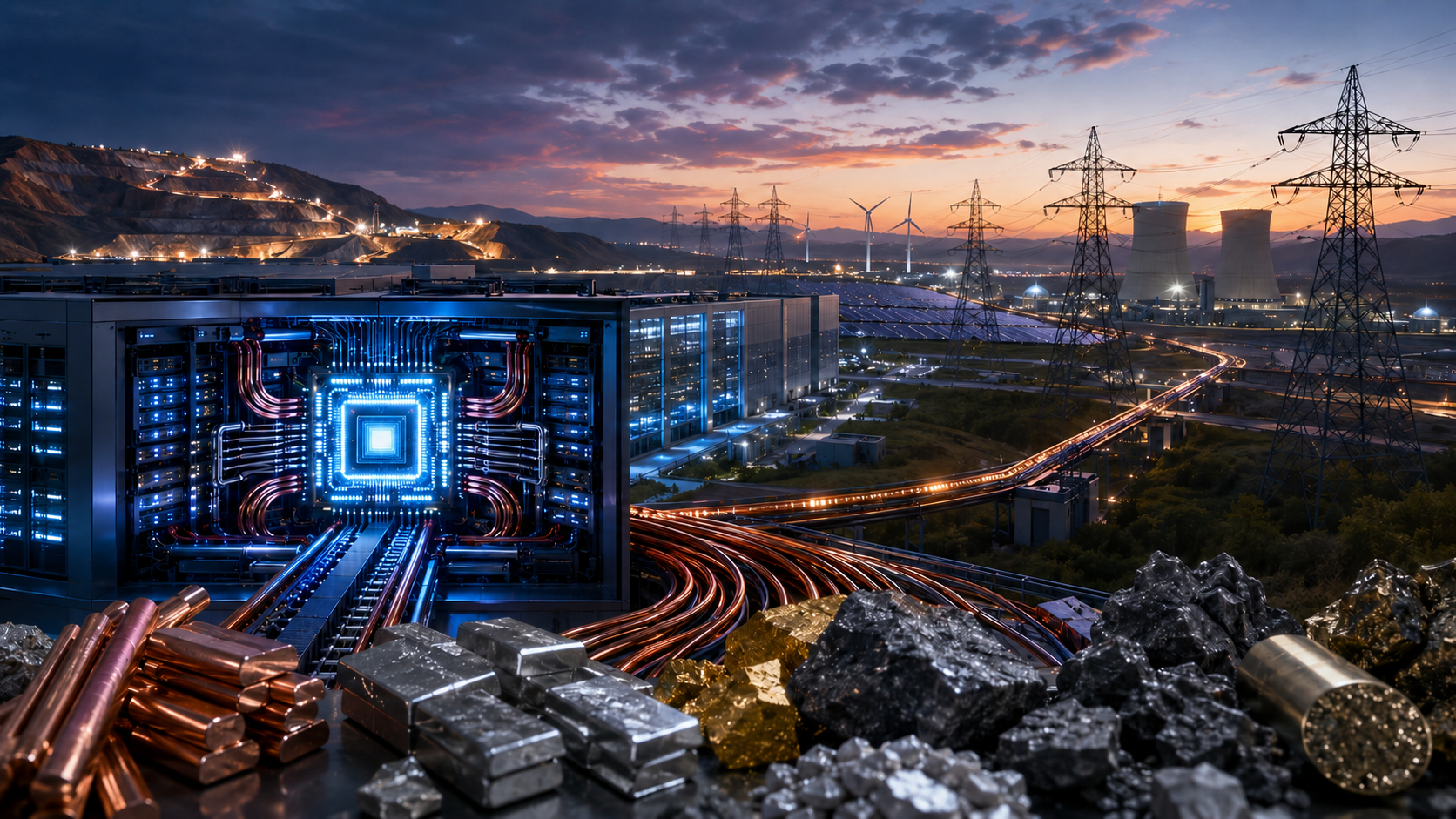
The artificial intelligence revolution is usually presented as a boom in semiconductors, software and computing power. But behind every AI model is an increasingly large physical infrastructure of data centers, electricity generation, transmission networks and strategic raw materials. The next major bottleneck for AI development may therefore be found not only in chips, but in energy, grids and metals.
The Physical Infrastructure Behind the AI Revolution
Artificial intelligence may appear to be a digital revolution, but its development depends on an enormous physical supply chain.
The core development chain can be summarized as:
AI growth → data centers → electricity demand → power generation → nuclear and uranium → grid expansion → copper and silver → advanced electronics and gold → critical minerals and rare earths.
Each stage creates demand for the next.
More powerful AI models require more computing capacity. More computing capacity requires larger data centers. Larger data centers require significantly more electricity. That electricity must be generated and then transported through transmission and distribution networks. Those networks require enormous quantities of copper and other conductive materials, while the servers, semiconductors, cooling systems and advanced electronics inside the data centers depend on a much broader range of strategic metals and minerals.
The result could be the emergence of a new long-term investment cycle in which the growth of artificial intelligence becomes increasingly connected to the global energy and metals markets.
AI Data Centers Are Becoming Major Electricity Consumers
The first part of the equation is electricity.
According to the International Energy Agency, global data centers consumed approximately 415 terawatt-hours of electricity in 2024, equivalent to around 1.5% of total global electricity consumption.
The IEA estimates that data-center electricity consumption had already been growing at approximately 12% per year over the preceding five years.
The acceleration expected from AI is considerably stronger.
In its base-case forecast, the IEA projects that global electricity consumption from data centers could reach approximately 945 to 950 TWh by 2030, close to double current levels and representing just under 3% of global electricity demand.
Between 2024 and 2030, data-center electricity demand is projected to grow at approximately 15% annually, more than four times faster than electricity consumption across most of the rest of the global economy.
The IEA’s updated analysis also found that global data-center electricity demand increased approximately 17% in 2025, while electricity consumption from AI-focused data centers increased by around 50%.
This is the central point: AI is creating a new category of electricity demand that is expanding far faster than the broader economy.
The United States and China Are at the Center of the AI Power Boom
The increase in electricity demand is highly concentrated.
According to the IEA, the United States and China are expected to account for nearly 80% of global growth in data-center electricity consumption through 2030.
- United States: Data-center electricity consumption could increase by approximately 240 TWh from 2024 levels, an increase of around 130%.
- China: Consumption could increase by approximately 175 TWh, representing growth of around 170%.
- Europe: Data-center electricity consumption is projected to increase by more than 45 TWh, or approximately 70%.
- Japan: Consumption could increase by approximately 15 TWh, or around 80%.
The United States already has the highest data-center electricity consumption per person. IEA estimates indicate approximately 540 kWh per capita in 2024, potentially increasing to more than 1,200 kWh per capita by 2030.
S&P Global has separately estimated that data centers could increase from approximately 5% of U.S. electricity demand today to as much as 14% by 2030.
At these levels, the AI investment cycle becomes an energy infrastructure problem as much as a technology problem.
Nuclear Power and Uranium Could Become Strategic AI Infrastructure
The rapid increase in data-center electricity consumption raises an obvious question: where will all this power come from?
Renewable energy will form an important part of the solution, but large-scale AI data centers also require reliable and continuously available electricity.
This is helping to revive interest in nuclear power.
Global nuclear generating capacity stood at approximately 398 GWe in mid-2025, with an additional 71 GWe under construction, according to data cited from the World Nuclear Association.
The relationship between nuclear power and the technology sector is becoming increasingly direct. Major technology companies are exploring or signing agreements linked to nuclear generation as they seek long-term sources of reliable electricity for data centers and AI infrastructure.
Amazon, for example, has entered agreements linked to electricity supplied from nuclear generation for its expanding data-center operations.
If this trend continues, uranium becomes an increasingly important upstream component of the AI infrastructure cycle.
Uranium Demand Is Forecast to Increase Sharply
The World Nuclear Association forecasts uranium requirements for nuclear reactors increasing approximately 28% by 2030, from around 67,000 metric tons in 2024 to approximately 85,000 metric tons.
By 2040, uranium requirements could more than double to above 150,000 metric tons annually.
Global uranium mine production recovered strongly between 2022 and 2024, increasing approximately 22% to around 60,213 metric tons.
In the short term, additional mine output and secondary supplies may be sufficient to support reactor requirements. The longer-term situation is considerably more challenging.
Developing new uranium mines can take approximately 10 to 20 years from initial resource discovery to production.
This creates one of the central characteristics of the potential AI metals supercycle: demand can accelerate much faster than new commodity supply can be developed.
If nuclear power becomes an important part of the solution to AI electricity demand, uranium supply may increasingly become a strategic constraint rather than simply another commodity market.
Copper May Be the Central Metal of the AI Infrastructure Boom
If uranium helps generate electricity, copper is essential for moving and using it.
Copper is required throughout the AI infrastructure chain:
- Electricity generation.
- High-voltage transmission networks.
- Local electricity distribution.
- Transformers and substations.
- Data-center electrical systems.
- Power cables and busbars.
- Cooling equipment.
- Servers and electronic equipment.
S&P Global describes AI and data centers as a new and rapidly expanding vector of global copper demand.
Its research forecasts copper demand associated with data centers increasing from approximately 1.1 million metric tons in 2025 to around 2.5 million metric tons by 2040.
By 2030, S&P Global estimates that AI-training data centers could account for approximately 58% of total copper demand associated with data centers.
The importance of this number extends beyond the copper physically installed inside data centers themselves.
Every major data-center development can also require additional power generation, transmission lines, substations and distribution infrastructure. The indirect copper requirement may therefore become as important as the copper used directly within the data-center facility.
The Copper Supply Problem Is Measured in Decades, Not Years
The difficulty is that copper supply cannot respond quickly.
According to S&P Global, the average development timeline for new copper mines is approximately 17 years.
The industry is also dealing with declining ore grades, increasing production costs, more complex extraction conditions, environmental restrictions, permitting delays and geopolitical uncertainty.
S&P Global warns that without significant additional investment and new production, the global copper market could face a potential supply shortfall approaching 10 million metric tons by 2040.
Recycling will provide additional supply, but recycled copper alone may not be sufficient to close a structural gap of this scale.
This creates a potentially significant mismatch.
The technology industry can build a new generation of AI chips in a matter of years. The mining industry may require nearly two decades to develop the copper resources needed to provide electricity to the infrastructure using those chips.
This mismatch between the speed of technological development and the speed of raw-material development could become one of the defining economic issues of the AI investment cycle.
Silver Has Both an Industrial and Monetary Role
Silver occupies a particularly interesting position within the metals complex because it functions simultaneously as a precious metal and an industrial metal.
Its exceptional electrical conductivity makes silver important in electronics, electrical contacts, circuit boards, solar technology and other advanced applications.
The expansion of AI does not mean that data centers themselves will suddenly consume the majority of global silver supply. The relationship is broader.
AI drives electricity demand. Electricity demand drives investment in generation and grid infrastructure. Expansion of renewable electricity generation, advanced electronics and digital infrastructure can then contribute to additional industrial silver demand.
At the same time, silver retains its monetary characteristics and can benefit from many of the same macroeconomic forces that influence gold, including inflation concerns, fiscal instability and declining confidence in fiat currencies.
This dual role gives silver an unusual position in a potential metals supercycle.
It can potentially benefit from both sides of the market: industrial infrastructure demand and monetary investment demand.
Gold Plays a Smaller but Highly Specialized Industrial Role
Gold is fundamentally different.
The majority of gold demand is associated with jewelry, investment and central-bank reserves rather than industrial consumption.
However, gold remains important in high-reliability electronics because of its conductivity and exceptional resistance to corrosion.
It is used in electronic connectors, semiconductor packaging, bonding applications and other environments where reliability is more important than material cost.
The direct impact of AI on global gold demand is therefore likely to remain relatively small compared with the monetary forces driving the gold market.
Nevertheless, gold occupies a unique position within the broader AI and metals thesis.
It can benefit modestly from the expansion of advanced electronics while simultaneously benefiting from the fiscal, monetary and geopolitical risks that may accompany the enormous capital investment required to finance the global AI infrastructure build-out.
Tungsten: A Critical Mineral, Not a Rare Earth
Tungsten is frequently grouped together with rare earths in general discussion, but technically it is not a rare-earth element.
It is better classified as a strategically important critical mineral.
Tungsten has one of the highest melting points of any metal and is valued for its hardness, heat resistance and performance under extreme conditions.
Its applications include advanced manufacturing, aerospace, defense, semiconductor production and specialist industrial equipment.
The semiconductor sector also uses tungsten-related materials in advanced chip manufacturing processes and interconnect technologies.
Supply concentration creates an additional strategic issue.
China accounts for an estimated around 80% of global tungsten production, giving the country substantial influence over an increasingly important supply chain.
This means the investment case for tungsten is not simply based on increasing demand.
It is also based on the strategic importance of developing reliable non-Chinese supply chains for advanced manufacturing and technology.
Rare Earths and Critical Minerals Form the Hidden Layer of AI Infrastructure
The AI infrastructure chain extends well beyond copper, uranium, silver and gold.
Advanced computing and electricity systems rely on a much broader collection of critical minerals, including rare-earth elements and specialist materials such as gallium and germanium.
Rare-earth permanent magnets containing elements such as neodymium and praseodymium are widely used in high-performance electric motors.
These applications extend across industrial automation, robotics, power systems and cooling equipment.
AI itself may therefore create both direct and indirect demand for critical minerals as the technology expands beyond data centers into robotics, autonomous systems and increasingly automated industrial processes.
The greatest risk is again supply concentration.
China maintains a dominant position in the mining, processing or refining of several strategically important minerals used by the global technology industry.
This creates the possibility that future AI development could become increasingly influenced by geopolitics and access to critical raw materials.
The semiconductor industry has already experienced the economic impact of chip shortages. A future infrastructure bottleneck could instead emerge in power availability, copper, uranium or critical-mineral processing capacity.
The S&P GSCI Industrial Metals Index as a Market Benchmark
The S&P GSCI Industrial Metals Index provides a useful market benchmark for monitoring broader industrial-metal performance.
The index tracks major exchange-traded industrial metals and can provide an indication of whether institutional capital is moving into or out of the sector.
However, it should not be considered a complete AI metals index.
The complete AI infrastructure thesis extends across several different commodity groups:
- Industrial metals such as copper.
- Precious and industrial metals such as silver.
- Monetary precious metals such as gold.
- Nuclear fuel commodities such as uranium.
- Critical minerals such as tungsten, gallium and germanium.
- Rare-earth elements used in advanced magnets and industrial systems.
No single traditional commodity index fully captures this entire chain.
Nevertheless, the S&P GSCI Industrial Metals Index remains useful as a broad indicator of the health of the industrial-metals cycle.
Research reviewed for this article indicated that the index remained positive for 2026 through early July after a strong performance during 2025. This supports the argument that recent weakness across parts of the metals complex should not automatically be interpreted as a broad structural selloff.
Correction, Consolidation or the End of the Metals Cycle?
Many metals have experienced periods of weakness or correction during 2026.
This is not surprising.
Higher interest rates, persistent inflation, a strong U.S. dollar and concerns surrounding global economic growth can place short-term pressure on commodity prices.
However, there is an important difference between a cyclical price correction and a deterioration in the underlying structural demand outlook.
At present, the evidence differs significantly between individual metals.
Gold and silver remain heavily influenced by Federal Reserve policy and monetary expectations. Copper is more directly exposed to global industrial activity and Chinese economic conditions. Uranium is driven primarily by the nuclear fuel cycle and long-term utility contracting. Critical minerals are increasingly influenced by supply concentration and geopolitics.
The markets should therefore not be treated as one homogeneous trade.
Nevertheless, the broader metals complex does not currently appear to be experiencing a universal structural collapse in demand.
Instead, many of these markets appear to be balancing short-term macroeconomic headwinds against increasingly strong long-term infrastructure requirements.
The Central Bottleneck: Technology Can Scale Faster Than Mines and Power Grids
This may be the most important conclusion of the analysis.
AI software can be improved rapidly.
Semiconductor generations can advance within a few years.
Data centers can be designed and constructed relatively quickly when electricity and infrastructure are available.
But power stations, transmission grids and mines operate on much longer development cycles.
A new copper mine may require approximately 17 years to develop. A new uranium resource can require 10 to 20 years before entering production. Major electricity transmission projects can face years of planning, permitting and construction.
This means the ultimate constraint on AI development may eventually shift away from computing technology.
The real constraint could become access to sufficient quantities of reliable electricity and the physical materials required to generate and distribute it.
ATN Analysis: AI Could Create a New Energy and Metals Supercycle
The technology investment boom has so far concentrated largely on semiconductors, software companies and hyperscale cloud infrastructure.
But this may represent only the first stage of the AI capital-investment cycle.
The second stage is physical.
AI data centers require electricity. Electricity requires generation capacity. Reliable baseload electricity may increase the importance of nuclear power and uranium. New power generation requires transmission and distribution networks. Those networks require copper and other metals. Advanced electronics require silver, gold and specialist materials. Semiconductor manufacturing and industrial automation require additional critical minerals and rare earths.
This creates a much broader economic chain:
AI → Computing → Data Centers → Electricity → Nuclear and Other Generation → Grid Infrastructure → Copper and Silver → Electronics → Critical Minerals and Rare Earths.
The fundamental investment argument is therefore not that every metal will rise continuously or that every commodity will experience an immediate shortage.
The argument is that AI has introduced an entirely new structural source of demand into energy and commodity markets that were already facing electrification, renewable-energy investment, electric vehicles, defense spending and supply-chain restructuring.
At the same time, increasing demand is colliding with one of the fundamental characteristics of the mining industry: supply responds extremely slowly.
This creates the conditions in which a genuine long-term supercycle can develop.
Conclusion: The AI Revolution Has a Physical Foundation
The AI revolution is not simply a semiconductor and software boom.
Its physical foundation is energy, electrical infrastructure and metals.
Global data-center electricity consumption could approximately double by 2030. Nuclear generating capacity is expanding. Uranium demand is forecast to increase significantly. Copper demand from data centers alone could more than double over the longer term, while the global copper industry faces mine-development timelines measured in decades.
Silver combines growing industrial relevance with its traditional monetary role. Gold remains primarily a monetary asset but continues to play a specialized role in advanced electronics. Tungsten and other critical minerals expose the AI supply chain to concentrated production and geopolitical risk.
The most important question may therefore no longer be how quickly AI technology itself can advance.
The question is whether the global energy, electricity and mining infrastructure can expand quickly enough to support it.
If it cannot, the next major bottleneck in artificial intelligence may not be computing power.
It may be physical power—and the metals required to deliver it.
Sources
- International Energy Agency – Energy Demand from AI
- International Energy Agency – Key Questions on Energy and AI
- S&P Global – Copper in the Age of AI: Challenges of Electrification
- S&P Dow Jones Indices – S&P GSCI Industrial Metals Index
- Reuters – Uranium Demand Forecast and World Nuclear Association Data
- World Nuclear Association – Nuclear Power and Uranium Market Research
- The Silver Institute – Global Silver Supply and Demand Research
- World Gold Council – Gold Demand and Technology Research
- Brookings Institution – Global Energy Demands Within the AI Regulatory Landscape
- FP Analytics – Artificial Intelligence and the Critical Minerals Crunch