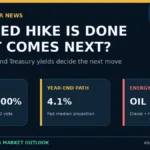
After the Fed raised rates to 3.75%–4.00%, oil, diesel, Treasury yields and late-September economic data became the next market drivers. The Federal Reserve’s quarter-point rate increase was already largely priced in. The unanimous vote and higher projected rate path shifted attention toward the persistence of inflation and the possibility of further tightening. … [Read more...] about The Fed Hike Is Done: What Comes Next for Markets in September 2026?
Interest Rates
The Fed’s Rate Hike May Be Priced In—Oil Will Decide What Comes Next

The latest 25-basis-point increase may already be largely reflected in Treasury yields, mortgage rates and business borrowing costs. The real question is whether oil-driven inflation will persist and lead markets to price another rate hike—and whether higher rates can do anything about the source of that inflation. The Rate Hike May Already Be Priced In There is little value … [Read more...] about The Fed’s Rate Hike May Be Priced In—Oil Will Decide What Comes Next
August 2026 Jobs Report: Payrolls Rebound, but CPI Holds the Real-Wage Verdict

The August 2026 employment report delivered the labor-market recovery that July failed to provide. Payrolls increased by 162,000, unemployment remained at 4.1%, average weekly earnings rose by approximately 0.56%, and aggregate private payrolls increased by 0.7%. That is positive for household income and near-term consumption. It is not, however, an uncomplicated market … [Read more...] about August 2026 Jobs Report: Payrolls Rebound, but CPI Holds the Real-Wage Verdict
Jackson Hole 2026: Warsh’s Higher-Rate Warning Leaves the Debt Question Unanswered

Jackson Hole 2026 produced a monetary-policy doctrine, but it did not produce a solution. Federal Reserve Chair Kevin Warsh delivered his clearest warning yet that rates may have to rise if inflation does not move back toward the Fed’s 2% target “clearly and at sufficient speed.” Yet he stopped short of recommending an immediate increase, offered no forward … [Read more...] about Jackson Hole 2026: Warsh’s Higher-Rate Warning Leaves the Debt Question Unanswered
U.S. Personal Income and Spending, July 2026: Shadows and Bright Spots Coexist

U.S. personal income and spending data for July 2026 confirm an economy in which shadows and bright spots are not taking turns—they are coexisting. Real wage growth has weakened, income from assets has lost purchasing power and households have drawn heavily on savings. At the same time, transfer receipts and lower personal taxes are supporting disposable income, while … [Read more...] about U.S. Personal Income and Spending, July 2026: Shadows and Bright Spots Coexist
What Is Stagflation? Why It Hurts the Economy and Financial Markets

Stagflation is the uncomfortable combination of persistent inflation, weak or stagnant economic growth and a deteriorating labor market. Prices remain under pressure even though the economy is losing momentum. That makes stagflation especially difficult for households, companies, investors and central banks. Stagflation in One Minute The word combines stagnation and … [Read more...] about What Is Stagflation? Why It Hurts the Economy and Financial Markets
July 2026 Employment Report: The Economy’s “Fort Alamo” Moment

July's labor data resemble a last defensive stand: the employment base is weakening, while aggregate real payroll purchasing power remains narrowly positive. Research updated: August 13, 2026 July's employment report is the most important economic report of the month—not because one headline settles the outlook, but because it shows how many people remain … [Read more...] about July 2026 Employment Report: The Economy’s “Fort Alamo” Moment
Fed Rate Pause or Hike? July CPI, Jobs, PPI and Oil Risks Point to a Better Policy Path

Weak payrolls and stagnant real wages argue against another interest-rate increase, while oil, producer prices and geopolitical risk prevent the Federal Reserve from declaring victory over inflation. The most credible policy is a disciplined pause—not a return to Bernanke-era quantitative easing. Research and forecast information updated August 13, 2026, before the July … [Read more...] about Fed Rate Pause or Hike? July CPI, Jobs, PPI and Oil Risks Point to a Better Policy Path
Yields Explained: What Bond Yields Mean for the Economy and Financial Markets

Bond yields are the price of money across time. They influence mortgages, government finance, corporate borrowing, currencies and the valuation of almost every major asset class. This guide starts with the basics, then builds toward the yield curve, real yields, term premiums and the market debate surrounding Federal Reserve Chair Kevin Warsh. What Is a … [Read more...] about Yields Explained: What Bond Yields Mean for the Economy and Financial Markets
The Warsh Fed Gave More Answers Than the Media Admits: What It Communicated and What Markets Said
The dominant media story was a divided Federal Reserve, three dissents and a chairman offering few answers. That framing misses the substance of the July decision. The Fed held rates steady because commodity-driven inflation, already-restrictive market yields and fragile real purchasing power require more judgment than an automatic rate increase. Much of the post-meeting … [Read more...] about The Warsh Fed Gave More Answers Than the Media Admits: What It Communicated and What Markets Said
Are the Doom-Sayers Right This Month? The Real Market Cracks and Financial Risks in July 2026

Market analysis as of July 22, 2026 — Are warnings of an imminent financial meltdown justified, or will markets adapt and continue through a new era of higher rates, AI investment and persistent volatility? Every Month Brings Another Market-Crash Warning Financial doom-sayers are identifying genuine vulnerabilities. The mistake is treating those vulnerabilities as proof that … [Read more...] about Are the Doom-Sayers Right This Month? The Real Market Cracks and Financial Risks in July 2026
30-Year Treasury Yield at 5.13%: 2007 Echoes, Fed Risk Imminent Crash or a New Economic Era?

Market analysis as of July 22, 2026 — 30-Year Treasury Yield at 5.13%: Does This Foretell an Imminent Crash Like 2008—or Signal a New Economic Era? The US 30-year Treasury yield has returned to approximately 5.13%, a level associated with the period immediately preceding the 2007–2008 financial crisis. At the same time, the 13-week Treasury bill yield is approximately 3.73%, … [Read more...] about 30-Year Treasury Yield at 5.13%: 2007 Echoes, Fed Risk Imminent Crash or a New Economic Era?
Gold and Precious Metals Outlook 2026: Monetary Headwinds Versus Fiscal Risk
Gold, silver and other precious metals delivered extraordinary gains through 2025 before entering a much more volatile environment in 2026. The central question for investors is now whether renewed monetary tightening will overpower the structural support coming from fiscal deficits, sovereign debt concerns, central-bank demand and geopolitical uncertainty. From the 2025 … [Read more...] about Gold and Precious Metals Outlook 2026: Monetary Headwinds Versus Fiscal Risk
Yield Curve Outlook June 2026: What Rising Long-Term Yields Mean for Markets and the Economy
The global yield curve environment has changed significantly. The deep inversions that dominated financial markets during the previous monetary tightening cycle have largely eased, but long-term borrowing costs remain high. As of mid-June 2026, the central issue is no longer simply whether yield curves are inverted. Investors, businesses and policymakers must now determine why … [Read more...] about Yield Curve Outlook June 2026: What Rising Long-Term Yields Mean for Markets and the Economy