
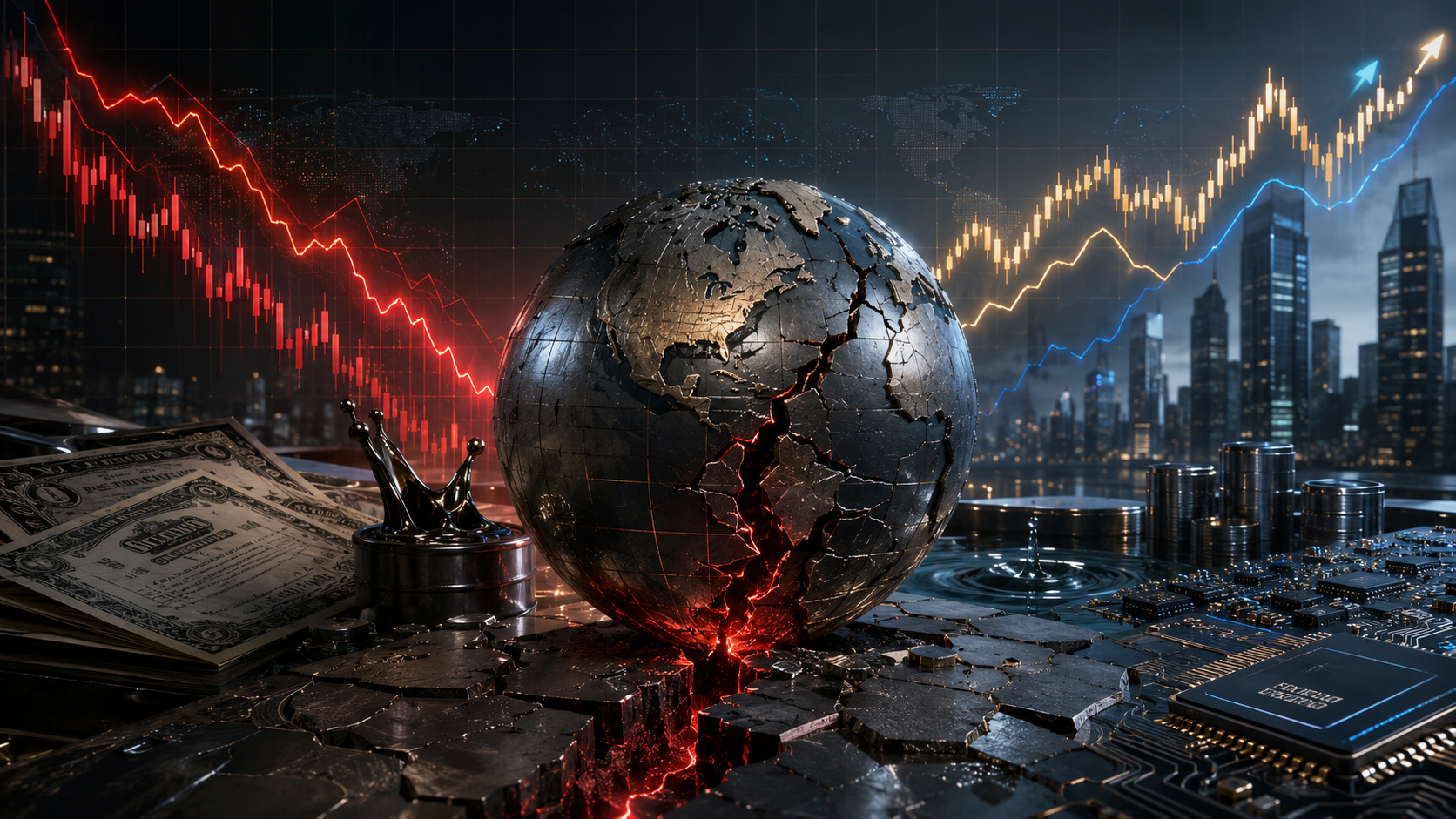
Market analysis as of July 22, 2026 — Are warnings of an imminent financial meltdown justified, or will markets adapt and continue through a new era of higher rates, AI investment and persistent volatility?
Every Month Brings Another Market-Crash Warning
Financial doom-sayers are identifying genuine vulnerabilities. The mistake is treating those vulnerabilities as proof that a financial meltdown is inevitable—or even the most likely next event.
There is an important difference between an expensive market, a vulnerable financial system and a system already entering crisis.
Our assessment as of July 22, 2026 is:
- A normal or substantial equity-market correction is entirely plausible.
- A prolonged repricing towards higher interest rates is already occurring.
- A 2008-style systemic collapse remains a tail risk rather than the present base case.
- Markets will probably adapt, but that adaptation may involve volatility, sector rotation, policy intervention and significant losses for investors positioned for the old low-rate regime.
The dramatic “one warning in a hundred” eventually appears correct because financial crises do happen. The problem is timing.
Someone who predicted a collapse every year from 2010 onwards could eventually claim victory, despite missing years of economic expansion and market gains. A useful warning must therefore do more than identify risk. It must explain the mechanism capable of turning that risk into forced selling, disappearing liquidity and systemic contagion.
What the Doom-Sayers Are Getting Right
The current financial system contains several genuine fault lines. None should be dismissed simply because previous crash predictions proved premature.
1. Long-Term Treasury Yields Above 5%
The 30-year US Treasury yield was trading around 5.13% to 5.15% on July 22, close to levels not sustained since before the global financial crisis.
That does not automatically signal another 2008. It does, however, change the valuation of almost every long-duration asset.
Higher long-term yields affect:
- Equity valuation models
- Mortgage and commercial-property financing
- Corporate refinancing
- Government debt-servicing costs
- Private-equity exit valuations
- Infrastructure and AI capital expenditure
- The relative attractiveness of equities versus bonds
The real danger is not a particular number such as 5.13%. It is the length of time that rates remain elevated and the amount of debt that must be refinanced under those conditions.
2. Elevated Equity Valuations and AI Concentration
Large equity indices remain heavily influenced by a relatively small group of AI, semiconductor and hyperscale technology companies. This concentration has helped the market advance, but it also means disappointing results from a few major companies can affect the entire index.
The Federal Reserve reported in May that forward equity price-to-earnings ratios remained towards the upper end of their historical distribution. It also identified AI valuations, debt-financed capital spending and the possibility of an AI-driven risk-asset correction among the concerns raised by market participants.
AI is not merely a stock-market narrative. It has become an enormous investment cycle involving data centres, semiconductors, electricity generation, transmission networks, cooling systems, natural gas, nuclear power and industrial metals.
That investment could produce a genuine productivity revolution. It could also create overcapacity, excessive leverage and disappointing returns if revenue fails to catch up with capital expenditure.
3. Hedge-Fund Leverage and Treasury-Market Fragility
Hedge-fund leverage remains one of the most important potential transmission mechanisms between an ordinary market correction and a broader liquidity event.
The Federal Reserve says hedge-fund leverage remains historically high and concentrated among the largest funds. Its data showed the largest hedge funds carrying substantially more balance-sheet leverage than smaller firms.
This matters because leveraged Treasury strategies can appear stable until volatility rises, financing terms tighten or margin requirements increase. Funds may then be forced to sell some of the world’s most important collateral precisely when market liquidity is deteriorating.
The risk is therefore not simply that Treasury prices fall. It is that leveraged holders become forced sellers while dealers lack the balance-sheet capacity to absorb the volume.
4. Government Deficits and Refinancing Requirements
The United States must finance large government deficits while refinancing maturing debt at substantially higher interest rates than those available during the post-2008 era.
Strong Treasury demand can allow this process to continue for years. However, persistent fiscal deficits can increase the term premium investors demand for holding long-dated government debt.
A disorderly Treasury auction, a sustained decline in overseas demand or a sharp rise in real yields would deserve more attention than the crossing of an arbitrary yield threshold.
5. Private Credit and Weaker Corporate Borrowers
Private credit has expanded rapidly by providing finance outside traditional public bond and bank-loan markets. This can diversify funding, but it also makes valuation, liquidity and interconnected exposures more difficult to observe.
The Federal Reserve reported that some riskier businesses—particularly those dependent on private credit—were experiencing difficulty servicing their debt. Certain business development companies also faced increased redemption requests and imposed limits on redemptions.
These restrictions do not yet constitute a system-wide freeze. They are nevertheless an early indication of where pressure may emerge when investors expect daily or periodic liquidity from assets that cannot be sold quickly without substantial discounts.
6. Oil, War, Tariffs and Renewed Inflation
Geopolitical conflict and a sustained oil-supply disruption could create the most dangerous combination for markets: weaker growth alongside higher inflation.
The Federal Reserve’s July Monetary Policy Report said inflation had moved higher, with total PCE inflation reaching 4.1% and core PCE inflation 3.4% over the 12 months to May. Tariffs, energy prices and demand for AI-related technology products were among the cited contributors.
This matters because a normal recession gives the Federal Reserve room to reduce rates. An inflationary slowdown can remove that freedom.
If unemployment rises while oil and tariffs keep inflation elevated, the Fed may be unable to provide the rapid monetary support markets have learned to expect.
What the Doom-Sayers Frequently Miss
A vulnerability is not the same thing as a trigger, and a correction is not automatically a systemic crisis.
The Federal Reserve’s latest assessments do not describe a financial system already entering a 2008-style breakdown.
- Bank regulatory capital ratios remain historically high.
- Most domestic banks continue to hold substantial liquid assets.
- Reliance on uninsured deposits remains well below its 2023 peak.
- Total household and business debt relative to GDP has declined towards levels last seen in the early 2000s.
- Most mortgage delinquency rates remain historically low.
- Investment-grade corporate credit quality remains robust.
- Corporate-credit spreads remain comparatively contained.
- Overnight money markets remain stable.
- Bank reserves are considered ample.
There are qualifications. Credit-card and auto-loan delinquencies are elevated relative to the past decade, riskier private-credit borrowers are under pressure and unrealised losses on fixed-rate bank assets have not disappeared.
Nevertheless, these are not the same conditions visible during the accelerating banking and mortgage crisis of 2007–2008.
The present market looks expensive, concentrated and highly rate-sensitive. It does not yet look like a funding system that has stopped functioning.
Why 2026 Is Not Simply a Replay of 2007
The comparison with 2007 is understandable. Long-term Treasury yields are back near similar levels, asset valuations are elevated and leverage has migrated into less transparent areas of the financial system.
But the financial architecture is different.
The 2008 crisis developed around poorly underwritten mortgages, opaque securitisation, fragile bank funding, thin capital and derivatives exposures that were not fully understood until counterparties began failing.
Today’s most visible vulnerabilities are more likely to involve:
- Leveraged nonbank financial institutions
- Treasury basis trades and repo financing
- Private-credit liquidity mismatches
- AI-related capital expenditure and debt issuance
- Commercial-property refinancing
- Sovereign borrowing and higher term premiums
- Geopolitical energy shocks
The next crisis, if one occurs, is unlikely to repeat the last crisis exactly. Investors looking exclusively for another subprime-mortgage collapse may miss the pressure building in government-bond financing, private markets or leveraged nonbanks.
The Market Will Find New Ways to Continue—but There Is Always a Cost
The financial system has become considerably more adaptive since 2008. Authorities now have stronger bank-capital requirements, stress tests, standing repo facilities, emergency lending mechanisms, deposit guarantees and experience deploying rapid asset-purchase programmes.
Central clearing is also being expanded across important Treasury and repo transactions, while regulators have greater visibility into many institutional and derivative exposures.
Financial markets contain enormous pools of private capital capable of purchasing distressed assets when prices become attractive. Meanwhile, AI, automation and productivity growth could help businesses absorb higher wages and financing costs.
But adaptation does not eliminate losses. It redistributes them.
- If authorities rescue liquidity, the cost may emerge through inflation, currency weakness or a larger public balance sheet.
- If policymakers protect the bond market, they may have less freedom to control inflation.
- If markets are allowed to clear naturally, asset prices, employment and weaker borrowers may suffer.
- If regulation protects banks, risk may migrate into private credit, hedge funds and other nonbank institutions.
The system usually survives. That does not mean every company, fund, strategy or investor survives with it.
Correction, Bear Market or Financial Meltdown?
These outcomes should not be treated as interchangeable.
Normal Correction
A decline of approximately 5% to 10% can occur because of positioning, earnings disappointment, seasonal weakness or profit-taking. Market liquidity continues to function and credit spreads remain controlled.
Substantial Repricing or Bear Market
A decline of 15% to 30% becomes more plausible if long-term yields continue rising, earnings expectations fall, AI capital expenditure slows or economic growth deteriorates. Credit conditions tighten, but the core banking and funding systems continue operating.
Systemic Financial Crisis
A true financial crisis involves more than falling share prices. It occurs when leverage, collateral and funding interact to create forced liquidations, counterparty fears and a withdrawal of credit.
The critical question is not whether the Nasdaq or S&P 500 falls. It is whether losses escape from asset markets and enter the financial plumbing.
Ten Signals That Would Turn the Warning into a Genuine Meltdown Risk
A 30-year Treasury yield near 5.13% is not sufficient by itself. Concern should rise substantially if several of the following appear simultaneously:
- Treasury yields rise while auction demand deteriorates sharply. Weak bid-to-cover ratios, larger auction tails and reduced indirect demand would indicate that buyers require materially greater compensation.
- Credit spreads widen rapidly across investment-grade and high-yield debt. Rising government yields are manageable while private credit remains available. A simultaneous repricing of sovereign and corporate debt is more dangerous.
- Repo rates become unstable or Treasury liquidity disappears. Stress in secured overnight funding would show that the problem has moved beyond valuation and into market infrastructure.
- Hedge funds face forced deleveraging and widespread margin calls. This could transform an orderly bond-market adjustment into a self-reinforcing liquidation.
- Bank deposits leave while bank credit-default-swap prices rise. Deposit outflows combined with a market-based rise in perceived bank risk would be more serious than either signal alone.
- Private-credit funds impose widespread redemption restrictions. Isolated restrictions can be contained. Restrictions spreading across multiple managers and strategies would indicate a broader loss of confidence.
- Unemployment rises while inflation remains too high for the Fed to cut. This would weaken borrowers while limiting the most familiar policy response.
- Oil surges because of a sustained geopolitical supply disruption. A prolonged energy shock could raise inflation, depress consumption and tighten financial conditions simultaneously.
- AI earnings fail to justify capital expenditure as financing costs rise. This could affect technology equities, corporate bonds, data-centre developers, utilities, energy infrastructure and private-credit lenders at the same time.
- The dollar, Treasuries and equities fall together. Simultaneous selling across the reserve currency, government debt and risk assets would be a significant warning that confidence in US assets themselves was deteriorating.
No single indicator confirms a crisis. The dangerous signal would be convergence: falling collateral values, widening credit spreads, unstable funding and forced deleveraging occurring together.
The More Probable Outcome: A New and More Volatile Economic Regime
The most probable outcome is neither effortless prosperity nor total financial collapse. It is a more demanding market environment characterised by:
- Higher nominal economic growth
- Higher average inflation than during the 2010s
- Higher long-term interest rates
- Powerful but uneven AI-driven productivity
- Greater competition for capital
- Repeated corrections and sector rotations
- Continued policy intervention when financial plumbing is threatened
In this environment, the largest risk may not be a single spectacular crash. It may be the gradual destruction of business models and investment strategies designed around permanently cheap money.
Companies with strong cash flow, pricing power and productive capital investment may adapt. Highly leveraged borrowers, speculative projects and assets valued on distant future earnings will face a much more difficult test.
What Traders and Investors Should Watch Now
Rather than responding to every dramatic prediction, traders can monitor whether market weakness is spreading across asset classes.
- Equities: Market breadth, AI leadership, earnings revisions and volatility
- Treasuries: Auction demand, term premiums, real yields and curve steepening
- Credit: Investment-grade and high-yield spreads, defaults and distressed exchanges
- Funding: Repo rates, dealer balance sheets and Treasury-market liquidity
- Banks: Deposit flows, liquidity, unrealised losses and CDS pricing
- Private credit: Redemptions, valuation adjustments and payment-in-kind interest
- Economy: Employment, real earnings, consumption and refinancing activity
- Inflation: Oil, tariffs, wages, housing and inflation expectations
A falling equity index is a market event. Falling equities combined with widening credit spreads and unstable funding is a financial-stability event.
Conclusion: Are the Doom-Sayers Right?
The doom-sayers are right that the financial system contains serious cracks. Long-term yields above 5%, hedge-fund leverage, private-credit stress, elevated equity valuations, debt-financed AI investment, government borrowing and geopolitical inflation all deserve close attention.
They are not yet supported by the evidence when they present an imminent 2008-style collapse as the inevitable next step.
The current evidence points towards an expensive and vulnerable system undergoing adaptation—not a funding system already in meltdown.
The market will probably find new ways to continue, but it may have to break parts of the old structure to build the new one.
That process may produce corrections, bear markets, failed companies and painful sector rotations. It may also create opportunities in the industries capable of thriving under higher rates, stronger productivity and a continuing AI infrastructure cycle.
The doom-sayers should therefore be heard—but their warnings should not be mistaken for a timetable.
Sources and Further Reading
- Federal Reserve — Financial Stability Report, May 2026
- Federal Reserve — Near-Term Risks to the Financial System, May 2026
- Federal Reserve — Funding Risks and Private Credit, May 2026
- Federal Reserve — Monetary Policy Report, July 2026
- Federal Reserve — AI, the Economy and the Financial System, May 2026
- US Treasury — Quarterly Refunding and Government Financing Documents
- US Treasury — Official Interest Rate Statistics