Frankfurter Bonds Explained: The Modern Repackaging of Corporate Trade Credit
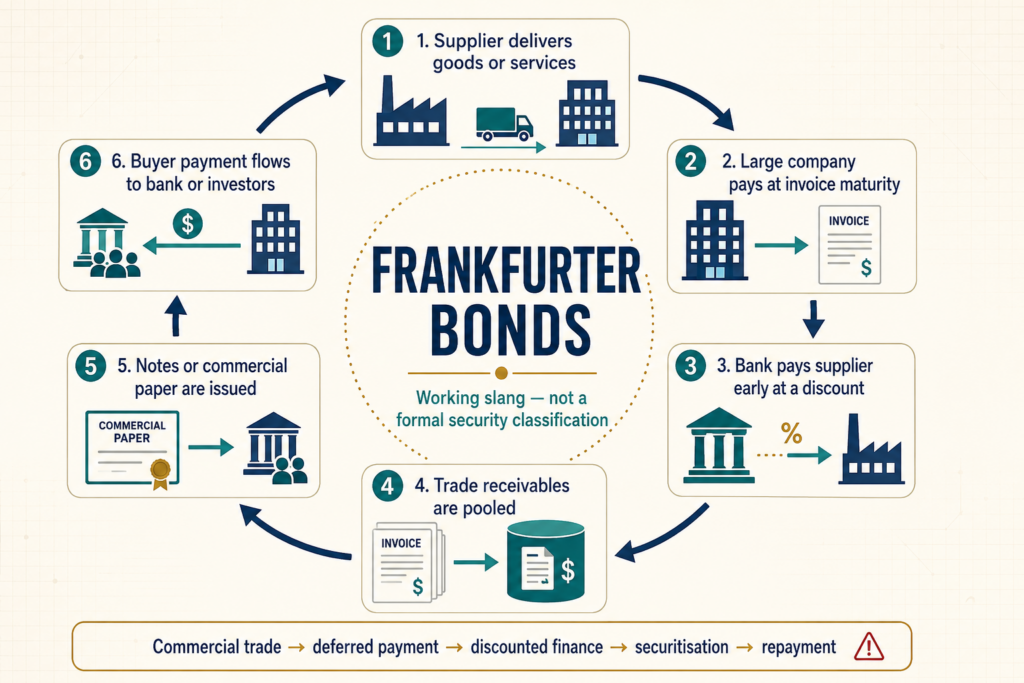
“Frankfurter bonds” is working financial slang rather than an official security classification. It describes a modern chain of corporate financing in which deferred invoices are discounted by banks or other intermediaries, pooled and potentially repackaged for investors.
What Are “Frankfurter Bonds”?
Large companies rarely settle every commercial transaction immediately. Goods and services are frequently supplied on credit, with payment due after 30, 60, 90 or more days.
The supplier therefore holds a trade receivable: a legally enforceable promise that the purchasing company will pay the invoice at maturity. If the supplier needs the money sooner, a bank or financial intermediary may provide early payment after applying a discount.
The expression “Frankfurter bonds” is used here as working slang for the modern financial sausage created when these individual payment obligations are combined, financed and, in some cases, converted into securities or commercial paper.
It is important to distinguish the slang from the legal terminology. The recognised mechanisms include:
- invoice discounting;
- factoring;
- supply-chain finance;
- payables finance;
- reverse factoring;
- trade-receivables securitisation; and
- asset-backed commercial paper.
How Corporate Trade Becomes a Financial Product
- A commercial transaction takes place: A supplier delivers goods, components, technology or services to a large corporate customer.
- Payment is deferred: The purchaser agrees to settle the invoice at a future maturity date.
- The supplier seeks early payment: Rather than waiting until maturity, the supplier sells or finances the receivable through a bank or another intermediary.
- A discount is applied: The supplier receives less than the invoice’s full face value. The difference represents the financing cost, fees and compensation for credit risk.
- The receivables are accumulated: Banks, funds or special-purpose vehicles may combine multiple invoices into a larger pool.
- The pool may be refinanced: Notes, commercial paper or other receivables-backed securities can be issued against the expected payments.
- The risk is redistributed: Investors receive the cash flows if the underlying corporate customers pay their invoices as expected.
Not every discounted invoice becomes a bond, and many arrangements remain on a bank’s balance sheet. Securities created from receivables may also be privately placed rather than listed on a public exchange. “Repackaged” is therefore more accurate than automatically describing every transaction as “re-listed.”
Why Companies Use This Financing
Trade and supply-chain finance performs a legitimate economic function. Suppliers can receive cash without waiting for invoices to mature, while large purchasers can preserve working capital and negotiate longer payment periods.
Smaller suppliers may also obtain financing based on the stronger credit standing of a large purchaser. This can make funding cheaper than borrowing independently, although the benefit becomes smaller when interest rates, bank charges or credit-risk premiums are high.
Receivables securitisation can provide additional liquidity by transforming individually illiquid invoices into financial instruments that can be held by a wider group of investors. The International Monetary Fund explains that trade receivables may be sold to a legally separate special-purpose vehicle, which can then issue collateralised notes or commercial paper.
Why Call Them “Frankfurter Bonds”?
The nickname captures the way numerous individual financial ingredients can be processed into one apparently standardised product. Each invoice may be genuine, commercially justified and relatively small. Once thousands of receivables are combined, however, investors may see only the packaged security rather than every underlying transaction.
The name is therefore a useful metaphor, but it should always be accompanied by the recognised financial terminology. It is not an official bond category, accounting definition or exchange classification.
The Similarity to 2005–2007
The comparison with 2005–2007 concerns the financing structure rather than the underlying assets.
During that period, banks increasingly originated loans, combined them into securities and transferred portions of the risk to outside investors. The International Organization of Securities Commissions documented the expansion of securitisation into new asset classes and the growth of the “originate-to-distribute” model.
The modern trade-receivables structure can follow comparable principles:
- credit is created through an original commercial transaction;
- the resulting payment obligation is transferred to a financial intermediary;
- multiple obligations are pooled;
- the pool may be divided into different risk levels;
- securities are sold to investors; and
- the original participants may no longer hold all the final credit risk.
However, similarity does not mean equivalence. Trade invoices are normally short-term claims connected to completed commercial activity. They are not automatically comparable with the long-dated, poorly underwritten mortgage debt that played a central role in the global financial crisis.
Where the Risks Begin
Extended Payment Periods
Large purchasers may use their bargaining power to extend invoice maturities. This improves the purchaser’s reported working capital but leaves suppliers waiting longer for payment or paying more for early access to their own revenue.
High Discounting Costs
When interest rates and credit spreads are elevated, discounting an invoice can become expensive. The financial pressure is then transferred down the supply chain, where smaller companies generally have less capacity to absorb it.
Hidden or Misclassified Borrowing
Supplier-finance obligations can economically resemble bank debt while continuing to appear alongside ordinary trade payables. This may make a company’s leverage, financing dependence and liquidity risk more difficult to assess.
New supplier-finance disclosure requirements under IAS 7 and IFRS 7 were introduced specifically to provide investors with more information about the effect of these arrangements on liabilities, cash flows and liquidity risk.
Concentration Risk
A receivables pool may contain thousands of invoices but still depend heavily on a small number of major purchasers, industries or financial intermediaries. The number of invoices can create the appearance of diversification without eliminating their shared economic exposure.
Refinancing and Withdrawal Risk
A company can become dependent on its supplier-finance programme. If a bank withdraws the facility, investors stop purchasing the securities or the purchaser’s credit rating deteriorates, the company may suddenly need to settle obligations using its own cash.
The US Securities and Exchange Commission has previously asked companies to consider disclosing whether termination of a supplier-finance programme could create a material risk.
Risk Separation
Once invoices are sold, pooled and distributed, the organisation originating or approving the credit may no longer bear the entire risk. This can weaken the incentive to investigate every underlying transaction as carefully as an institution intending to retain it until maturity.
Addendum: Pro Soluto or Pro Solvendo—Who Ultimately Bears the Risk?
The central issue within the “Frankfurter bonds” structure is not merely that corporate receivables are assigned, discounted or securitised. The decisive question is how the credit is assigned and who remains responsible if the final debtor fails to pay.
The two principal forms of assignment are known as pro soluto and pro solvendo. In international financial terminology, these broadly correspond to non-recourse and with-recourse financing.
| Assignment | English equivalent | Primary insolvency risk | If the debtor defaults |
|---|---|---|---|
| Pro soluto | Non-recourse | The assignee, factor or purchaser of the receivable | The assignee generally absorbs the covered credit loss and cannot recover it from the original creditor solely because the debtor became insolvent. |
| Pro solvendo | With recourse | The original creditor or assignor remains exposed | The assignee may demand repayment, reimbursement or repurchase of the unpaid receivable from the assignor, subject to the contract. |
Pro Soluto: The Insolvency Risk Is Transferred
Under a genuine pro soluto assignment, the original creditor transfers the receivable without remaining responsible solely for the final debtor’s insolvency. The bank, factor, special-purpose vehicle or other purchaser assumes the covered credit risk.
If the debtor fails because it is insolvent, the financial loss therefore falls upon the entity that purchased the receivable—or upon investors if that risk has subsequently been transferred through securitisation.
This provides an important advantage to the supplier. It can convert a future payment into present liquidity while obtaining greater certainty about its cash flow. A genuine transfer may also support accounting derecognition when the applicable requirements concerning risks, rewards and control have been satisfied.
However, pro soluto does not necessarily release the assignor from every possible liability. The assignor may remain responsible for matters such as:
- the legal existence and validity of the invoice;
- fraud or misrepresentation;
- duplicate or previously assigned invoices;
- commercial disputes concerning the goods or services;
- returns, rebates, credit notes or invoice dilution;
- breaches of contractual warranties; and
- receivables that fail to meet the agreed eligibility criteria.
The transfer of insolvency risk must therefore be distinguished from liability for a defective, disputed or fraudulent receivable.
Pro Solvendo: The Risk Can Return to the Supplier
Under a pro solvendo assignment, the supplier receives early payment but remains responsible if the final debtor does not pay. The transaction may resemble a secured advance against invoices more than a complete sale of credit risk.
If the debtor defaults, the bank or factor may exercise its contractual recourse against the supplier. It may require the supplier to reimburse the advance, replace the unpaid invoice or repurchase the receivable.
This provides the financier with two potential sources of repayment:
- payment from the final corporate debtor; and
- recourse against the original supplier if that payment is not received.
Because the financier receives this additional protection, a pro solvendo arrangement may carry a lower discount or financing charge than a comparable non-recourse transaction. However, the supplier has obtained liquidity without completely removing the underlying credit risk.
Why This Distinction Is Central to Frankfurter Bonds
When receivables are pooled and converted into notes or commercial paper, investors may appear to be purchasing exposure to a diversified collection of corporate invoices. The real risk cannot be understood without examining the recourse provisions behind those invoices.
In a pro soluto structure, debtor insolvency risk moves from the supplier to the factor, bank, special-purpose vehicle or investors. In a pro solvendo structure, the apparent transfer may conceal a continuing obligation that can send the loss back through the chain to the original supplier.
The effective risk pathway can therefore be summarised as follows:
- Pro soluto: debtor default → factor, bank, insurer, special-purpose vehicle or investors absorb the covered loss.
- Pro solvendo: debtor default → factor seeks recovery from the original supplier → supplier must fund the repayment.
This difference determines whether the transaction genuinely transfers credit risk or primarily provides short-term liquidity against an obligation that remains economically connected to the supplier.
The Accounting Label Is Not Enough
Calling a transaction pro soluto does not automatically prove that all material risks have been transferred. Regulators and accounting standards examine the economic substance of the arrangement, including retained guarantees, first-loss positions, repurchase obligations and continuing involvement.
Bank of Italy supervisory guidance states that factoring transactions should be treated as pro solvendo, irrespective of their contractual form, when they do not achieve a full transfer of the risks and rewards associated with the assets under IFRS 9.
Similarly, IFRS 9 requires an assessment of whether substantially all the risks and rewards of ownership have been transferred, retained or shared before determining whether a financial asset can be removed from the transferor’s balance sheet.
The Advantages and Risks of Each Structure
Pro Soluto Advantages
- The supplier receives cash-flow certainty.
- Covered debtor-insolvency risk is transferred.
- The supplier is protected from a qualifying debtor default.
- A genuine transfer can improve working-capital management.
- The factor has a stronger incentive to examine the debtor’s creditworthiness.
Pro Soluto Risks
- Credit losses become concentrated within banks, factors, insurers or investment vehicles.
- Risk may be underestimated when many invoices depend on the same industry or group of debtors.
- The financing cost can be higher because the purchaser assumes the insolvency risk.
- Complex securitisation can make the ultimate holder of the risk difficult to identify.
Pro Solvendo Advantages
- The supplier obtains liquidity before invoice maturity.
- The discount may be lower because the financier retains recourse.
- The financier has an additional source of recovery.
- The arrangement can continue supporting trade when investors are unwilling to accept the debtor risk alone.
Pro Solvendo Risks
- The supplier remains exposed to the debtor’s failure.
- Potential repayment obligations may be underestimated or insufficiently visible.
- A wave of debtor defaults can produce simultaneous claims against numerous suppliers.
- Suppliers may face a liquidity crisis precisely when their customers are already under stress.
- Recourse can create a chain reaction through the commercial and banking system.
The Potential Chain Reaction
The systemic risk becomes greater when the market assumes that credit risk has been transferred, while the contracts actually allow that risk to return to the original suppliers.
If a major corporate debtor fails to pay, a bank holding pro solvendo receivables may demand reimbursement from multiple suppliers. Those suppliers may then need emergency financing, delay payments to their own creditors or default on other obligations. What initially appears to be the failure of one large debtor can consequently spread through an entire supply chain.
By contrast, a genuine pro soluto structure stops the contractual insolvency loss from returning to the supplier. The loss remains within the financial structure, although it can still affect banks, insurers, special-purpose vehicles and investors.
Questions Investors Should Ask
- Were the receivables assigned pro soluto or pro solvendo?
- Does “non-recourse” cover every default or only formally defined insolvency events?
- Can disputed invoices, credit notes or ineligible receivables be returned to the supplier?
- Has the supplier guaranteed any portion of the pool?
- Is there a first-loss reserve, overcollateralisation or repurchase obligation?
- Has the credit risk been insured, and how strong is the insurer?
- Has the supplier removed the receivable from its balance sheet?
- Who bears the loss if both the debtor and the supplier become insolvent?
- Are investors relying on the debtor, the supplier, the bank or all three?
Conclusion to the Addendum
The real quality of a Frankfurter bond cannot be assessed solely from the value or number of invoices within its pool. The central question is where the loss goes when an invoice is not paid.
A pro soluto assignment transfers the covered insolvency risk away from the original creditor. A pro solvendo assignment preserves recourse against that creditor and can send the loss back through the commercial supply chain.
For this reason, the distinction between pro soluto and pro solvendo is not a minor contractual detail. It is the mechanism that determines whether credit risk has genuinely been transferred, merely redistributed or only temporarily concealed.
Why Frankfurter Bonds Should Not Automatically Alarm the Market
The existence of discounted invoices and receivables-backed securities is not, by itself, evidence of an approaching financial crisis. Trade finance supports production, employment, inventories and international commerce. When properly structured, it can improve liquidity throughout the corporate supply chain.
The current system also operates with stronger bank-capital rules, greater regulatory attention and better disclosure requirements than existed before the 2007–2008 financial crisis.
The market can therefore remain supported, provided that:
- the underlying invoices represent genuine commercial activity;
- purchasers remain capable of paying at maturity;
- payment periods do not expand uncontrollably;
- banks apply realistic credit standards;
- financing costs remain manageable for suppliers;
- risk concentrations are disclosed; and
- securitisation does not obscure the identity or quality of the underlying obligations.
The appropriate response is cautious monitoring, not immediate market alarm.
What Investors Should Monitor
The most important warning signs are not the bonds themselves but changes in the behaviour of the underlying system:
- rapidly lengthening corporate payment terms;
- increasing use of supplier finance to support operating cash flow;
- high invoice-discount rates imposed on smaller suppliers;
- receivables growing substantially faster than sales;
- large differences between reported trade payables and economic borrowing;
- heavy dependence on a single bank or financing platform;
- increasing payment delays, disputes or defaults;
- repeated refinancing of obligations that should have been settled; and
- complex securities for which investors cannot identify the underlying corporate exposures.
Three Possible Scenarios
1. Orderly and Supportive
Corporate purchasers pay at maturity, banks maintain conservative credit standards and suppliers obtain reasonably priced liquidity. Frankfurter bonds remain a useful component of working-capital finance.
2. Growing Financial Pressure
Payment periods become longer, discounting costs rise and weaker suppliers sacrifice more of their margins to receive cash. The system continues operating, but financial stress accumulates below the largest corporations.
3. A Wider Credit Event
Major purchasers delay payment, banks reduce facilities and investors stop refinancing receivables-backed instruments. Suppliers then face a sudden liquidity shortage, potentially transmitting problems through interconnected industries and financial institutions.
This third scenario is the risk that should be monitored, but it should not be presented as the current base case without supporting evidence.
Conclusion
“Frankfurter bonds” provides a memorable name for the modern repackaging of corporate trade credit. Behind the slang is a real and important financial structure: goods are delivered, payment is deferred, suppliers obtain discounted early payment and the resulting receivables may be pooled or converted into marketable instruments.
The mechanism has similarities to the risk-distribution practices that expanded between 2005 and 2007, particularly when credit is originated, repackaged and transferred away from its source. Nevertheless, trade-receivables finance is not inherently dangerous and should not automatically concern the wider market.
The decisive questions are whether the invoices are genuine, whether the purchasers can pay, how much the financing costs, where the final risk resides and whether the structure remains transparent. For now, the correct position is neither complacency nor alarm, but cautious and continuous observation.