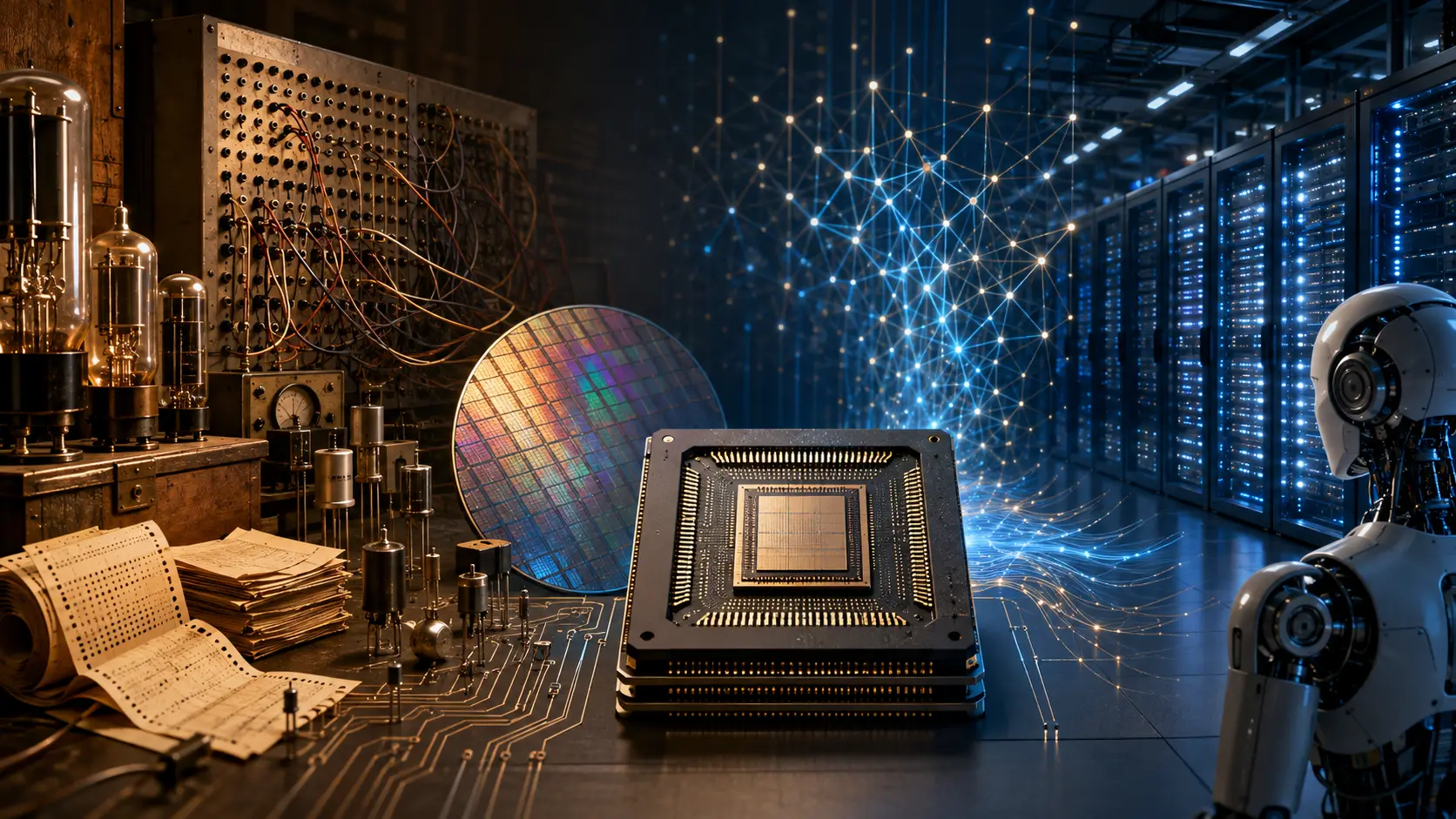
Artificial intelligence was imagined by people, built from physical materials and trained on human-created data. Engineers designed the machinery and the learning process, but they did not manually program every capability that emerged.
The biography of AI is therefore not the story of a machine that suddenly became alive. It is the story of several scientific family lines—mathematics, neuroscience, statistics, computer science and semiconductor engineering—finally converging after decades of experiments, failures and unexpected discoveries.
Before AI Had a Name: The Mechanical Ancestors
Artificial intelligence has a birth date, but it also has ancestors. In the 1830s, Charles Babbage designed the Analytical Engine, a programmable mechanical computer that was never completed in his lifetime. In 1843, mathematician Ada Lovelace recognized that such a machine could manipulate not only numbers but also symbols, letters and musical notes. Her notes included what is often described as the first published computer algorithm.
Lovelace also identified a question that still follows AI today: would a machine originate ideas, or would it only execute human instructions? The Science Museum describes her insight as part of the prehistory of general-purpose computing.
A century later, electronic computers transformed that mechanical dream into working machinery. In 1943, neurophysiologist Warren McCulloch and logician Walter Pitts described a simplified mathematical neuron. Their model was not a map of the whole human brain. It was an abstraction showing that networks of neuron-like units could perform logical operations.
In 1950, Alan Turing reframed the philosophical argument. Instead of first settling what it means to think, he proposed an imitation game in which a machine’s conversational behavior could be compared with that of a person. His paper, Computing Machinery and Intelligence, became the foundation of what is now called the Turing Test.
1955–1956: The Birth and Naming of Artificial Intelligence
The phrase artificial intelligence was coined by John McCarthy in a 1955 proposal for a summer research project at Dartmouth College. McCarthy, Marvin Minsky, Nathaniel Rochester and Claude Shannon proposed that aspects of learning and intelligence could be described precisely enough for a machine to simulate them.
The workshop took place in 1956 and is generally treated as the formal birth of AI as a field. It did not produce a finished intelligent machine. Its importance was that it gave a name, identity and research program to a collection of ideas that had previously been scattered across mathematics, psychology, information theory and engineering. Dartmouth records the 1956 meeting as the birthplace of the discipline.
Two Competing Families: Rules Versus Learning
From its earliest years, AI developed through two broad approaches.
Symbolic AI: Tell the Machine the Rules
Symbolic researchers represented knowledge with facts, symbols and logical rules. If programmers supplied enough reliable knowledge, the computer could search possible solutions and reach a conclusion. This approach produced theorem provers, planning systems, game-playing programs and, later, expert systems used in fields such as medicine and engineering.
Its weakness was the cost and rigidity of writing the world down by hand. Reality contains exceptions, ambiguity and changing conditions. A program could be brilliant inside its carefully defined domain and helpless outside it.
Connectionism: Let the Machine Learn the Pattern
Connectionists built networks of simple mathematical units inspired loosely by biological neurons. Instead of explicitly coding every rule, researchers supplied examples and a method for adjusting the strength of the network’s connections.
Frank Rosenblatt’s perceptron, demonstrated in the late 1950s, was an early physical neural network for pattern recognition. Arthur Samuel’s checkers program offered another essential idea: a computer could improve through experience. His 1959 work helped establish the term machine learning.
Modern AI contains both traditions. Neural networks dominate perception and generation, while search, logic, retrieval, software tools and human-defined rules remain vital. AlphaGo, for example, combined deep neural networks with search rather than relying on either method alone.
AI Timeline: The People, Inventions and Turning Points
| Year | People or organization | Breakthrough | Why it mattered |
|---|---|---|---|
| 1843 | Ada Lovelace and Charles Babbage | Analytical Engine notes and a published algorithm | Established the idea that a general-purpose machine could manipulate symbols, not only calculate numbers. |
| 1943 | Warren McCulloch and Walter Pitts | Mathematical model of an artificial neuron | Connected brain-inspired structures with logical computation. |
| 1947 | John Bardeen, Walter Brattain and William Shockley | Transistor effect | Made electronic computation smaller, cooler, faster and more reliable than vacuum-tube machines. |
| 1950 | Alan Turing | Computing Machinery and Intelligence | Turned “Can machines think?” into a practical behavioral test. |
| 1955–1956 | John McCarthy, Marvin Minsky, Nathaniel Rochester and Claude Shannon | Dartmouth proposal and workshop | Named artificial intelligence and established it as a research discipline. |
| 1957–1958 | Frank Rosenblatt | Perceptron | Demonstrated a trainable brain-inspired pattern-recognition machine. |
| 1958–1959 | Jack Kilby and Robert Noyce | Integrated circuit | Placed multiple electronic components on a compact chip and opened the path to modern microelectronics. |
| 1959 | Arthur Samuel | Self-improving checkers program and “machine learning” | Showed that a program could learn to play better than the person who wrote it. |
| 1966 | Joseph Weizenbaum | ELIZA chatbot | Showed how simple pattern matching could produce a powerful illusion of understanding. |
| 1966–1972 | SRI International | Shakey the Robot | Integrated vision, planning, navigation and action in an early mobile AI system. |
| 1970s | AI research community | First AI winter | Funding and confidence fell when limited hardware and brittle programs failed to meet inflated promises. |
| 1971 | Federico Faggin, Ted Hoff, Stan Mazor and Masatoshi Shima | Intel 4004 microprocessor | Put a programmable central processor on a commercial chip and accelerated mass computing. |
| 1980s | Edward Feigenbaum and the expert-systems community | Commercial expert systems | Brought rule-based AI into companies, but high maintenance costs and narrow capabilities later contributed to another downturn. |
| 1982–1986 | John Hopfield; David Rumelhart, Geoffrey Hinton and Ronald Williams | Associative neural networks and backpropagation | Provided practical mechanisms for storing patterns and training multilayer networks from their errors. |
| 1989–1998 | Yann LeCun and collaborators | Convolutional neural networks for handwriting | Demonstrated commercially useful neural recognition, including reading bank checks. |
| 1997 | IBM Deep Blue team | Defeat of chess champion Garry Kasparov | Showed the power of specialized processors, massive search and expert knowledge in a defined domain. |
| 2006–2009 | Hinton and collaborators; Fei-Fei Li and the ImageNet team; NVIDIA | Deep-network training, ImageNet and general-purpose GPU computing | Algorithms, large labeled datasets and parallel hardware began to arrive at the same time. |
| 2012 | Alex Krizhevsky, Ilya Sutskever and Geoffrey Hinton | AlexNet wins the ImageNet challenge | GPU-trained deep learning decisively outperformed traditional hand-engineered computer vision. |
| 2014 | Ian Goodfellow and collaborators | Generative adversarial networks | Two competing networks learned to generate increasingly convincing synthetic data. |
| 2016 | Google DeepMind | AlphaGo defeats Lee Sedol | Combined neural networks, reinforcement learning and search to master a game once considered resistant to brute force. |
| 2017 | Ashish Vaswani and Google researchers | Transformer architecture | Attention mechanisms enabled highly parallel training and better handling of relationships across long sequences. |
| 2018–2020 | OpenAI, Google and the wider research community | Large pretrained language models | One model could learn broadly from large text collections and then adapt to many different tasks. |
| 2020 | Demis Hassabis, John Jumper and the AlphaFold team | AlphaFold2 | Demonstrated that deep learning could solve a major scientific prediction problem at extraordinary scale. |
| 2022 | OpenAI | Public release of ChatGPT | Put conversational generative AI into the hands of a mass global audience. |
| 2024–2026 | Global AI industry and research community | Multimodal models, reasoning systems, agents and physical AI | AI increasingly interprets multiple media, uses software tools and moves from answering questions toward completing bounded tasks. |
The timeline reveals why AI repeatedly appeared to fail and then return. Many of its central ideas were available decades before the world possessed enough digital data, computing power, memory bandwidth or affordable storage to make them useful at scale.
AI’s Physical Body: Hardware, Materials and Infrastructure
AI is often described as software living in “the cloud,” but there is nothing weightless about it. Every model depends on a long physical chain extending from mines and chemical plants to semiconductor fabs, power grids, fiber networks and cooling systems.
From Vacuum Tubes to Transistors
Early electronic computers used bulky vacuum tubes that consumed substantial power, produced heat and frequently failed. The 1947 transistor breakthrough at Bell Laboratories replaced these fragile switches with much smaller semiconductor devices. Bardeen, Brattain and Shockley received the 1956 Nobel Prize in Physics for research leading to the transistor effect.
The next step was the integrated circuit. Jack Kilby and Robert Noyce developed methods for combining multiple components on one piece of semiconductor material. The commercial microprocessor then placed a programmable processing unit onto a chip. Intel’s 4004, released in 1971, demonstrated that a general-purpose processor could be mass-produced and controlled through software.
Silicon, Light and Copper
Most modern logic and memory chips begin with extremely pure silicon derived from silica. Manufacturers grow a crystal ingot, slice it into wafers and build microscopic layers of conducting, insulating and semiconducting materials upon it. Photolithography repeatedly projects circuit patterns onto those layers. The most advanced extreme-ultraviolet systems use light with a wavelength of 13.5 nanometers, according to ASML’s guide to chipmaking.
Tiny quantities of other elements alter silicon’s electrical properties. Metal connections carry signals between transistors; insulating films keep the pathways separate. IBM’s adoption of copper interconnects in the 1990s helped chips become faster and more reliable.
An advanced AI processor is consequently not “made from sand” alone. Its production requires ultrapure water, specialty gases, photoresists, silicon wafers, copper and other metals, precision optics, ceramics, organic package substrates and a global network of highly specialized machines and suppliers.
Why the GPU Changed AI
A conventional CPU is designed to perform a broad range of tasks, often with a relatively small number of powerful cores. A graphics processing unit contains many parallel computing units originally developed to calculate pixels. Neural-network training also requires enormous numbers of similar matrix operations, making GPUs unusually well suited to the task.
NVIDIA’s CUDA platform opened GPU parallel processing to general-purpose scientific workloads in 2006. In 2012, AlexNet used GPUs to train a deep network on more than one million ImageNet examples and achieved a decisive improvement in image recognition. The AlexNet paper became one of the defining documents of modern deep learning.
Memory Became as Important as Arithmetic
Modern AI processors can calculate rapidly, but they must continually retrieve model parameters and move data. That makes memory bandwidth a central constraint. High-bandwidth memory, or HBM, stacks memory dies close to the processor and connects them through advanced packaging. TSMC describes its CoWoS technology as a foundation for integrating AI processors with HBM stacks.
At data-center scale, thousands of accelerators must exchange information through high-speed electrical and optical networks. Storage systems hold training data and checkpoints. CPUs coordinate workloads. Power electronics convert and distribute electricity, while air or liquid cooling removes heat. The apparent intelligence on a screen is supported by racks, cables, pumps, transformers and power stations.
AI’s Hardware Family Tree
- Vacuum tubes: made electronic digital computation possible but were large, hot and unreliable.
- Transistors: miniaturized the electronic switch.
- Integrated circuits: combined many components on a single chip.
- Microprocessors and CPUs: made programmable computing widely available.
- GPUs: supplied the parallel arithmetic required for large neural networks.
- AI accelerators: optimized matrix operations, lower-precision arithmetic and model inference.
- HBM and advanced packaging: moved large quantities of model data close to the processor.
- Data-center clusters: joined compute, memory, storage and networking into a machine larger than any single chip.
- Edge chips and robotics: brought trained models into phones, vehicles, drones, machines and humanoid forms.
This physical expansion carries an economic and energy cost. The U.S. Department of Energy estimated that data centers used about 4.4% of U.S. electricity in 2023 and could reach approximately 6.7% to 12% by 2028. AI progress is therefore increasingly linked to chip-fabrication capacity, memory supply, electrical generation, grid connections and cooling—not only to better algorithms. See the Department of Energy assessment.
What Engineers Designed—and What the Machine Discovered
The statement that engineers “built the circuitry and then AI took on a life of its own” contains an important truth, but it compresses several different stages into one sentence.
| Humans design or choose | The training process learns |
|---|---|
| Processor, memory, network and data-center architecture | The numerical weights stored in memory |
| Neural-network structure and mathematical operations | Useful internal features and representations |
| Training objective, error measure and optimization method | Statistical relationships that reduce the training error |
| Data collection, filtering and labeling | Patterns, associations, biases and regularities present in that data |
| Fine-tuning, testing, safety controls and product permissions | How learned capabilities combine and sometimes generalize to unfamiliar tasks |
During training, the model produces an answer, measures its error and adjusts vast numbers of connection weights. This cycle is repeated across enormous datasets. No programmer writes a separate instruction for every face, sentence or situation the model will encounter. The useful representation is discovered through optimization.
This was one of Geoffrey Hinton’s defining contributions. The 2024 Nobel Prize materials explain that Hinton developed methods through which networks could independently discover properties in data. Hinton was inspired by the brain, but artificial neural networks are simplified mathematical systems rather than digital replicas of biological brains.
Several breakthroughs were nevertheless surprising even to their creators. Researchers deliberately designed backpropagation, convolution, attention, reinforcement learning and training objectives. But they often discovered the full value of those inventions experimentally. Scale also produced capabilities that were not individually programmed: translation, summarization, coding, few-shot adaptation and combinations of concepts learned across different data sources.
The correct description is therefore neither “engineers programmed everything” nor “the machine invented itself.” Modern AI is a partnership between human design and machine-learned discovery.
Did AI Take on a Life of Its Own?
As a metaphor, the phrase captures something real: the behavior of a trained neural network is not a simple line-by-line expression of its programmers’ judgment. Models can find solutions their designers did not anticipate, combine learned abilities in unexpected ways and fail for reasons that are difficult to explain.
But AI has not been shown to be biologically alive or conscious. A deployed language model normally does not rewrite its underlying weights during an ordinary conversation. It operates on physical hardware, within software and permissions created by people. Its goals are provided through training objectives, prompts, system instructions or an external agent framework.
The distinction becomes more important with AI agents. A model connected to memory, software tools, databases, browsers, robots or weapons can take actions rather than merely produce words. The model itself has not become a living organism, but the system around it can give its outputs real-world consequences and a limited form of operational autonomy.
This is why control is no longer only a philosophical question. NIST’s work on AI agent standards addresses systems capable of autonomous actions, while warning that tool-connected agents create new security and governance risks.
AI did not come alive. It became capable of learning internal strategies that humans did not explicitly write, then acquired access to tools through which those learned strategies could affect the outside world.
The Next Chapter: From Language to Agents and Physical AI
The 2017 Transformer made it practical to train models that could weigh relationships across large sequences and run efficiently on parallel hardware. Large-scale pretraining then allowed one model to acquire broad abilities before being adapted or instructed for particular tasks.
OpenAI’s public release of ChatGPT on November 30, 2022 changed AI from a specialist technology into a mass-market interface. Multimodal systems subsequently combined text, images, audio and video. Reasoning-oriented models allocated more computation to solving difficult problems. Agents began using browsers, code, databases and enterprise software.
The next convergence is between generative intelligence and machines that move. Industrial robots have existed for decades, but AI is improving perception, natural-language instruction and adaptation. The International Federation of Robotics reported 542,000 industrial robot installations in 2024, more than twice the annual number installed ten years earlier. Humanoid robots remain an emerging and unproven category, but they represent an attempt to place general-purpose AI inside environments designed for human bodies.
AI’s biography has therefore moved through several forms:
- an idea—could intelligence be described mathematically?
- a program—could rules reproduce expert reasoning?
- a learner—could a machine improve from examples?
- a foundation model—could one trained system perform many tasks?
- an agent—could the model plan and use tools?
- a physical system—could learned intelligence perceive and act in the material world?
Each transition increases both usefulness and risk. A chatbot can generate an incorrect answer; an autonomous system can act on one. The future of AI will consequently be determined not only by model intelligence but by who controls the infrastructure, which objectives are selected, what permissions systems receive and whether human institutions develop as quickly as the technology.
Conclusion: AI Was Engineered, Trained and Discovered
The life story of artificial intelligence is not a straight march from invention to superintelligence. It is a seventy-year cycle of optimism, disappointment, persistence and rediscovery built on a much older history of mathematics and mechanical computation.
No single person created modern AI. Turing framed the question; McCarthy named the field; McCulloch, Pitts and Rosenblatt developed brain-inspired computation; Hopfield, Hinton, LeCun, Bengio and many others made neural learning practical; Fei-Fei Li and collaborators supplied essential data; semiconductor engineers supplied the processing power; and later teams built transformers, generative models, scientific AI and agentic systems.
Engineers created the circuitry, architecture and rules of learning. The trained networks then discovered internal patterns that were not individually written or always fully understood. That is the source of AI’s extraordinary power—and the reason its next stage requires judgment, safeguards and accountability equal to its technical ambition.
Selected Primary and Institutional Sources
- Dartmouth College: Artificial Intelligence Coined at Dartmouth
- Alan Turing: Computing Machinery and Intelligence and the Turing Test
- Computer History Museum: Brain-Inspired Neural Networks
- Nobel Prize: Inventions Behind Machine Learning with Artificial Neural Networks
- Reuters: Hopfield and Hinton Win the 2024 Nobel Prize in Physics
- ACM: 2018 Turing Award to Bengio, Hinton and LeCun
- Krizhevsky, Sutskever and Hinton: AlexNet
- Google Research: Attention Is All You Need
- Google DeepMind: AlphaGo
- Google DeepMind: AlphaFold
- ASML: How Microchips Are Made
- TSMC: CoWoS Advanced Packaging and High-Bandwidth Memory
- U.S. Department of Energy: Data-Center Electricity Demand
- Stanford HAI: 2026 AI Index Report
- NIST: Artificial Intelligence Risk Management Framework